Q2 2026 Vault Performance Update: AlphaVault ETH and Theoriq Gold Vault
Quick Summary
Gold does not pay a yield, yet in its first full quarter, Theoriq Gold Vault made it pay one anyway and is the strongest performer among tokenized-gold yield vaults. AlphaVault ETH, six months into 2026, has not printed a negative month. For the second quarter, AlphaVault ETH returned +1.20%, a net APY of 4.85%, bringing year-to-date performance through June to approximately +1.98% in ETH terms; Theoriq Gold Vault returned +0.97%, a net APY of 3.92%, denominated and compounding in gold terms.
All figures net of fees, as of June 30, 2026, sourced from infinity.theoriq.ai.
A quarter that tested the strategy set
The second quarter was defined by broad deleveraging across DeFi following the aftermath of the Aave/Kelp DAO rsETH dislocation. Liquidity tightened, borrow demand softened, utilization rates normalized after volatile periods, and many carry opportunities compressed as market participants prioritized balance sheet preservation over yield maximization. It was one of the more difficult environments for leveraged carry strategies in recent quarters.
Conditions like these punish strategies that depend on leverage being cheap and liquidity being deep. They also create a different kind of opportunity. Funding dislocations emerged across lending venues as borrow costs diverged between chains and protocols. Redemption mechanisms periodically drifted from secondary market pricing. Liquidity fragmentation increased between venues. Environments like this have historically favored allocators capable of dynamically reallocating capital and actively optimizing collateral, and that is where both portfolios concentrated.
"Institutional investing in digital assets requires more than generating yield. It requires transparent risk management, verifiable execution, and the ability to adapt capital efficiently across an increasingly fragmented market. That's what we've continued to build throughout the quarter,” Theoriq CPO Jameson Pickett said regarding performance through Q2.
The result is visible in where returns came from. Across both vaults, performance was driven primarily by relative value opportunities, funding dislocations, cross-venue credit spreads, and USD carry rather than directional exposure. When funding conditions deteriorated, leverage was reduced. When redemption pricing diverged from secondary markets, those dislocations were captured. Neither vault depended on the market moving in its favor, and return generation in the Theoriq Gold Vault was largely independent of gold price direction.
The Q2 highlight: multi-layer execution validation
The most significant development of the quarter was infrastructure. Theoriq's proprietary multi-layer execution validation framework was deployed and refined across both vaults during the period, and it changes what has to happen before any capital moves.
Before a transaction executes, it must clear quorum from at least two-thirds of a network of Trusted Execution Environment nodes that independently evaluate the proposed action. Each transaction is checked against a frozen policy set at runtime, with anything outside the trusted policy rejected by default, and then simulated in forked environments that replicate the portfolio's current state, so the expected impact on collateral balances, debt levels, liquidity positions, and exposures is validated before deployment rather than discovered after it.
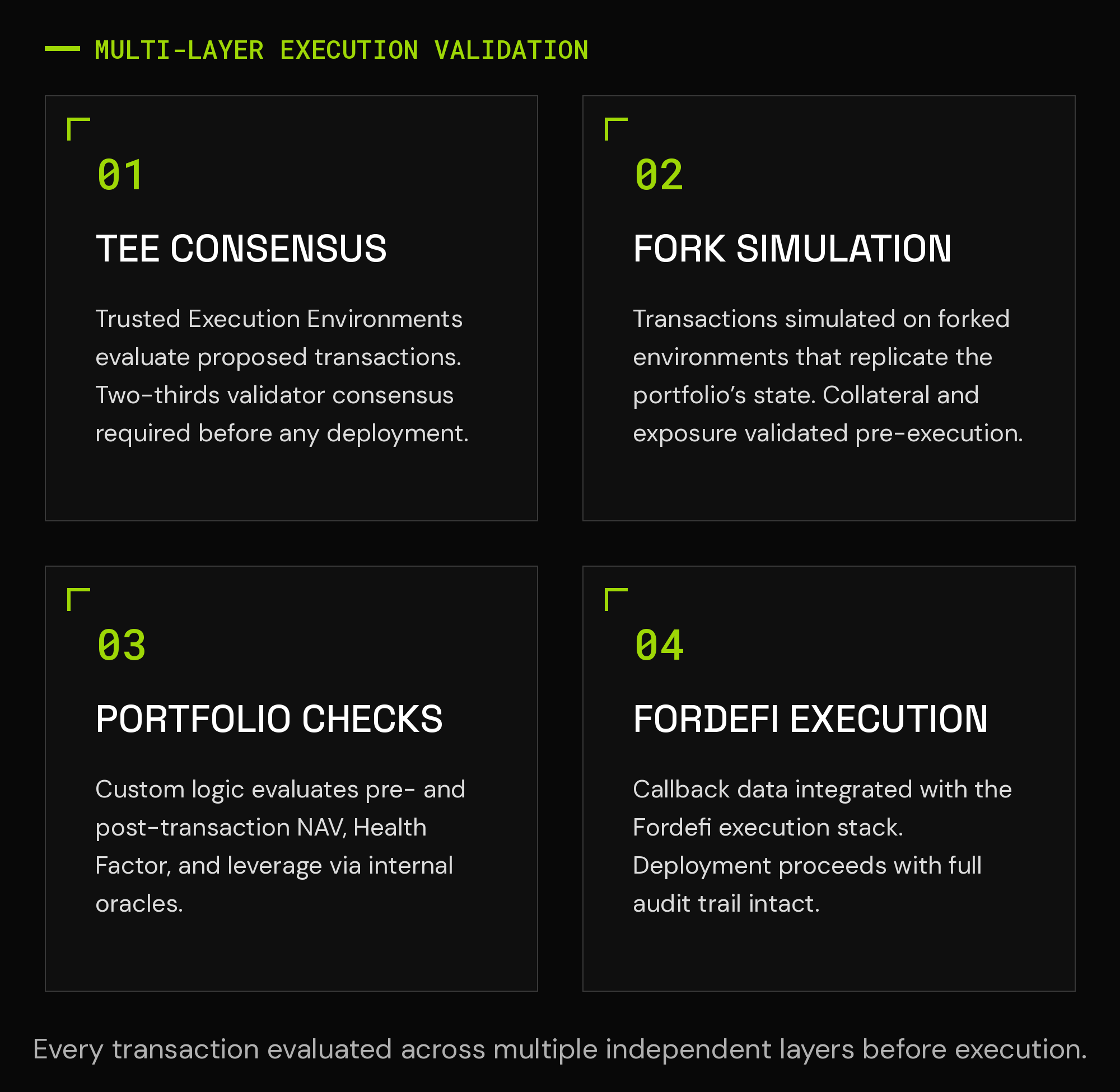
Callback data from the Fordefi execution stack then feeds a final layer of portfolio-specific verification, where custom logic evaluates both pre- and post-transaction portfolio states against internally maintained oracle and accounting systems. These automated validations include:
- Net Asset Value (NAV) verification before and after execution
- Health Factor and leverage monitoring across supported lending venues
- Collateralization and borrowing constraint validation
- Strategy-specific risk parameters and allocation limits
- Custom portfolio rules and execution constraints defined by the investment process
These controls operate in addition to the native safeguards already provided by Fordefi and the underlying protocols, so every transaction crosses multiple independent layers of verification before execution can occur.
Curators set the strategy and the risk limits. Execution is agentic by design, and no single human or AI can move funds alone: every transaction is independently checked inside a quorum of Trusted Execution Environment (TEE) nodes before it goes onchain. The result is execution assurance at every stage of the lifecycle, observable rather than assumed.
AlphaVault ETH
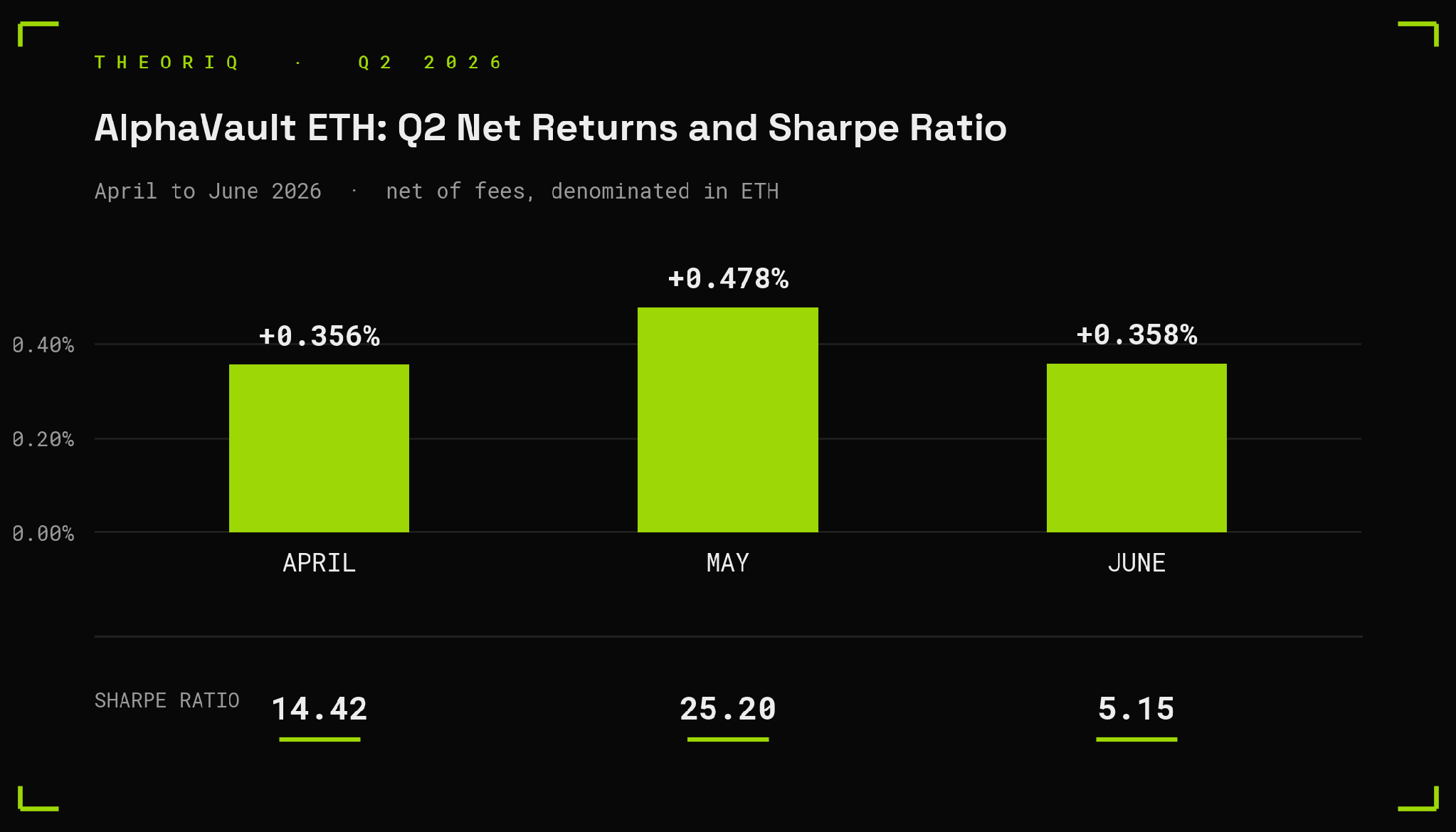
AlphaVault ETH returned +0.356% in April, +0.478% in May, and +0.358% in June, compounding to +1.20% for the quarter against a difficult backdrop for onchain credit, with net APY stepping up from the first quarter.
The strategy set continued to broaden through the quarter. ETH credit and staking-related yield remain the foundation, with leverage treated as a tool rather than a structural feature: it is deployed only when incremental carry sufficiently exceeds funding costs, and it is reduced when conditions deteriorate or better opportunities appear elsewhere in the book.
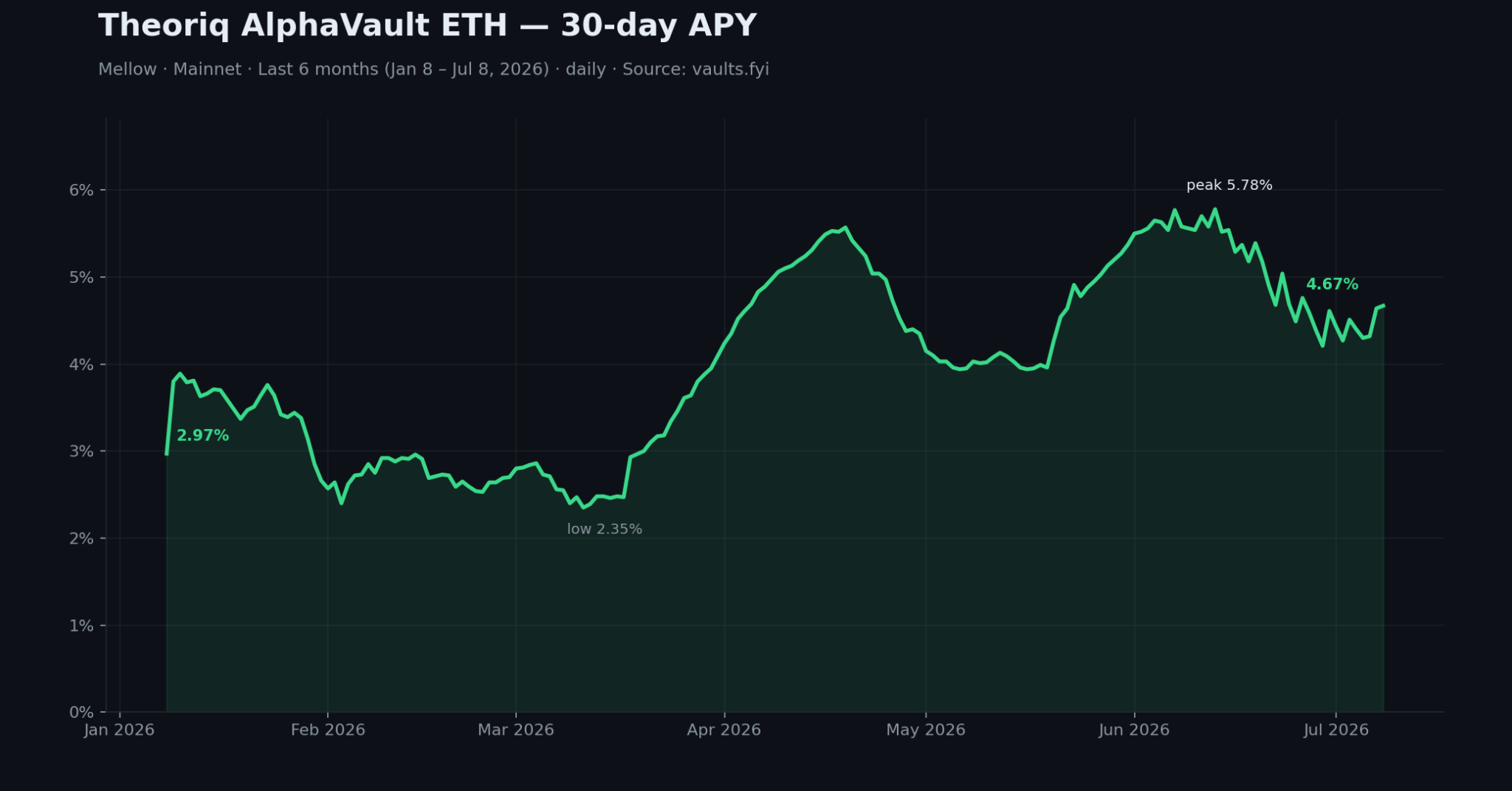
Third-party data tells the same story. On vaults.fyi, the vault's 30-day APY climbed from a first-quarter low of 2.35% to a peak of 5.78% in June, standing at 4.67% as of July 8.
A growing share of returns now originates from cross-venue and cross-chain relative value: positions that capture pricing differences between related instruments or venues. The vault operates across Aave, Morpho, and Euler deployments on mainnet, Plasma, Monad, and HyperEVM, borrowing where capital is cheapest and deploying where risk-adjusted yields are most attractive. As this infrastructure has matured, the portfolio has shifted from isolated strategy silos to portfolio-level collateral optimization, which lets capital move to the strongest opportunity without duplicating balance sheet.
Pendle remains an important layer. Principal Token structures stayed attractive in several markets even as carry compressed across DeFi, with favorable discounts to par offering superior risk-adjusted returns relative to traditional lending. Where liquidity and funding economics support it, the vault applies leverage to PT positions listed on pooled lending markets such as Aave, with sizing kept deliberately conservative. Representative positions during the period included PT-Sierra and PT-srUSDe, entered at implied yields averaging approximately 11 percent and above 5 percent respectively.
The fourth pillar, USD carry and tokenized RWAs, expanded meaningfully. The vault is integrated with a growing universe of institutional-grade, USD-denominated assets including Sierra, NeutrlUSD, reUSD, reUSDe, USD3 (3Jane), and the senior tranche of Avant Protocol, with additional RWA-backed opportunities under active review. Risk-adjusted performance improved materially during the period, reflecting stronger execution and the growing contribution of market-neutral strategies.
Theoriq Gold Vault
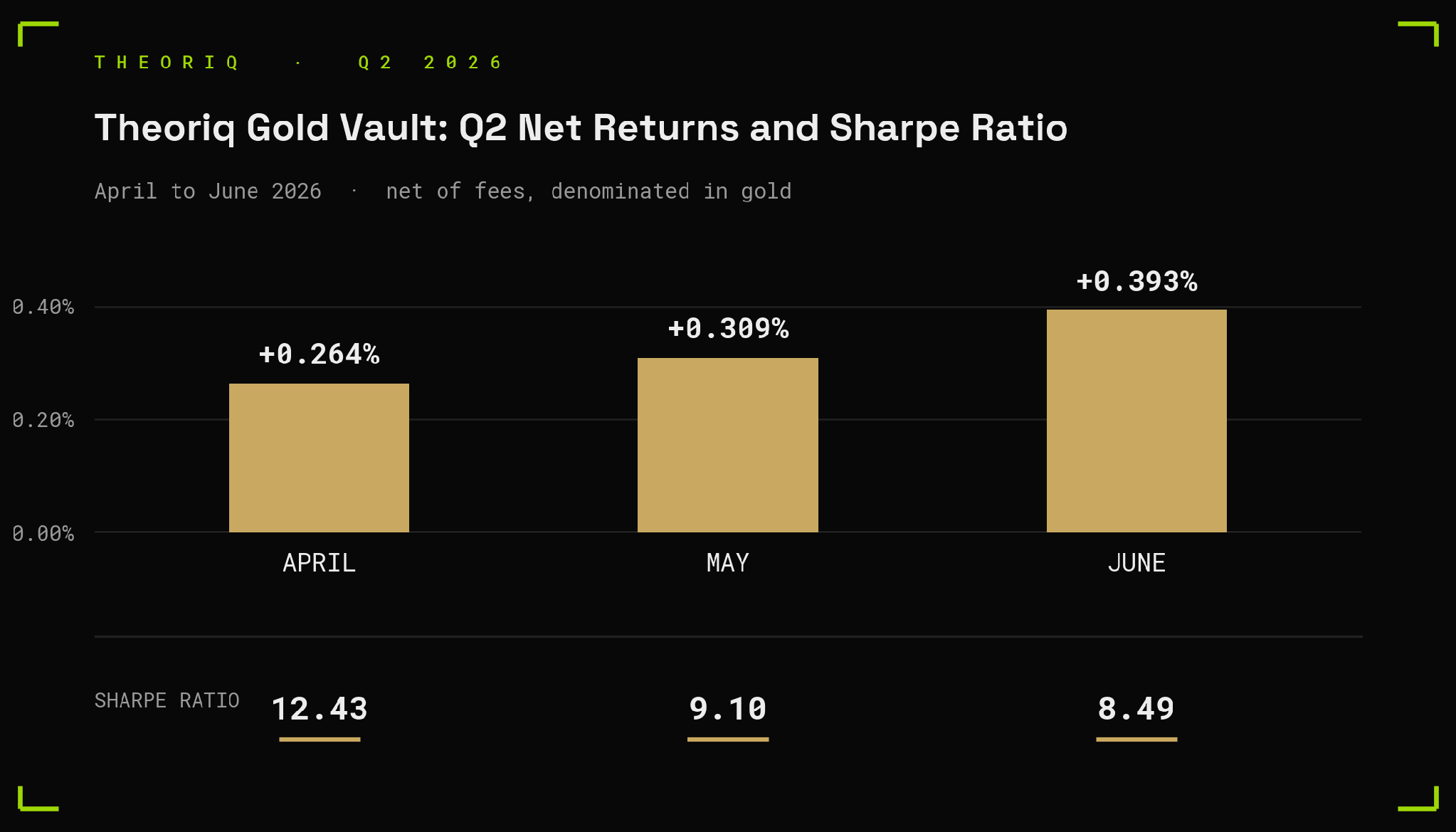
Theoriq Gold Vault completed its first full quarter with returns of +0.264% in April, +0.309% in May, and +0.393% in June, each month stronger than the last.
The construction is simple and disciplined. The vault holds XAUt as high-quality collateral, borrows USDC and USDT within conservative loan-to-value limits, and deploys that liquidity across Aave Mainnet, Aave Plasma, Morpho Mainnet, Euler on Monad, Feather on Celo, and related venues based on prevailing funding costs and liquidity conditions. Automated deleveraging infrastructure through Fordefi keeps the portfolio within its operating limits as conditions change, and realized yield compounds in gold terms.
The Celo deployment deserves its own note. Theoriq Gold Vault is live on Feather on Celo, the chain where tokenized gold already lives: more than 100,000 XAUt0 holders, roughly 90 percent of the tokenized-gold holder base, sit on Celo today. Celo's sub-cent transaction costs keep the vault's borrow, deploy, and rebalance loop economical. Feather curates a dedicated, isolated XAUt0/USDT Morpho market for the vault, with a Chainlink oracle, conservative loan-to-value limits, and continuous underwriting of the collateral behind the market.
Four strategy families deploy the vault's borrowed stablecoin liquidity, structured to avoid directional exposure to gold or the underlying markets:
- Cross-chain lending arbitrage captured differences in funding rates and utilization between venues, which widen during stress.
- Pendle Principal Token structures provided defined-return profiles with reduced directional uncertainty.
- Redemption and relative value trades monetized temporary dislocations between redemption value and secondary market pricing in stablecoins, structured assets, and tokenized RWAs.
- Delta-neutral capacity was retained for deployment when basis opportunities justify the complexity, an optionality that stayed mostly idle in a compressed quarter.
The through line: return generation was driven by funding spreads, collateral efficiency, and relative value rather than by gold moving in the vault's favor. Live positions are observable onchain via DeBank.
Discipline before yield
Both vaults expanded their tokenized RWA pipelines during the quarter, and every asset considered for deployment passes a structured diligence process before capital moves. Transparency and verification come first: preference goes to assets supported by independent attestations, third-party audits, and verifiable reporting, with positions and collateral flows monitored directly onchain where possible. Liquidity and redemption infrastructure comes second: primary redemption mechanisms and secondary market depth are evaluated against expected position sizing, so positions can be exited as efficiently as they are entered. Security and operational controls come third: battle-tested infrastructure, comprehensive audit histories, MPC custody, multisignature frameworks, and clearly defined privileged-role protections.
Protocols evaluated under this framework during the period include Sierra, NeutrlUSD, reUSD, reUSDe, USD3 (3Jane), Royco and Strata tranches, and the senior tranche of Avant Protocol. Incremental yield is not pursued at the expense of any of the three pillars. The full frameworks are detailed in each report.
Looking to Q3
Return generation is expected to continue coming from relative value, funding dislocations, RWA-backed carry, and market structure inefficiencies. Specific drivers include lending spread capture across fragmented venues, Pendle opportunities as term markets reprice, redemption-related dislocations, and cross-chain funding arbitrage. As liquidity conditions normalize and infrastructure matures, additional opportunities are expected to emerge across lending markets, redemption pathways, and structured yield products. Both vaults enter the third quarter with broader strategy sets, deeper infrastructure, and growing pipelines of institutional-quality opportunities.
The pipeline is already moving. As announced this week, a memorandum of understanding with DigiFT establishes a controlled pilot in which a regulated tokenized money market fund, part of a category that RWA.xyz sizes at approximately $14.85 billion dollars in tokenized U.S. Treasuries. This points at the same destination as everything else in this report: regulated assets made productive inside transparent, risk-managed on-chain credit markets.
Two vaults, nine positive-return months between them, and a partnership pipeline constantly growing. The mandate does not change: keep the assets productive, keep risk inside its limits, and keep every position verifiable on-chain.
ABOUT THEORIQ
Theoriq is a DeFi strategy curator. It curates on-chain vaults that turn tokenized assets into risk-managed yield: curators set the strategy and the risk limits, and AI-assisted systems execute and monitor within them. Its flagship vault, AlphaVault ETH, applies this framework to ETH-native yield, and the Theoriq Gold Vault extends it to tokenized gold.
IMPORTANT INFORMATION
This report is provided for informational purposes only and does not constitute an offer to sell or a solicitation of an offer to buy any security or financial instrument, and it is not investment, legal, or tax advice. Past performance is not indicative of future results. Figures are unaudited, net of fees unless otherwise noted, and sourced from infinity.theoriq.ai as of June 30, 2026. Digital asset strategies involve significant risk, including possible loss of principal.
About Theoriq
Theoriq builds the risk and yield intelligence layer for tokenized markets. It turns tokenized assets into risk-managed yield through multi-asset and infra-agnostic DeFi vaults: curators set the strategy and the risk limits, and AI-assisted systems execute and monitor within them. Its flagship vault, AlphaVault ETH, applies this framework to ETH-native yield, and the Theoriq Gold Vault extends it to tokenized gold, with plans to extend the model to additional real-world assets. Learn more at theoriq.ai.