Earn: The Next Growth Engine for Exchanges
Retail spot lost the flows that made it profitable. What replaces it is a better business, and it is built with partners rather than alone.
BitMEX and BitMart both announced wind-downs in the last week of July. Neither came with a detailed public explanation, and nobody outside those companies knows the full picture. What is observable is the condition they closed into: spot volume across centralized venues fell to $1.05 trillion in April, a two-year low, and the same quarter saw Gemini post a $582.8 million loss for 2025 and Coinbase reduce headcount by about 14 percent.
In a bear market, retail spot cannot carry the operating cost of a large exchange. Take rates compress, frequency collapses, and the fixed cost of compliance, custody, and engineering does not move. The business replacing it is yield on idle balances: recurring rather than episodic, scaling with assets rather than volatility.
Theoriq curates on-chain vaults across ETH and tokenized gold, with regulated real-world assets next, so what follows is our view from inside the yield layer.
Earn monetizes the balance, not the trade
Transaction revenue requires a customer to act and scales with volatility, which makes it weakest exactly when a business most needs stability. Balance revenue accrues whether or not the customer opens the app, and monetizes the largest neglected asset an exchange holds. On most venues, customer assets have never been a revenue line. They have been a custody cost.
Coinbase's largest services component is stablecoin revenue, earned on balances rather than trades, and its services line reached a record 44 percent of net revenue in the first quarter of 2026. Gemini disclosed that services and interest revenue exceeded transaction revenue in the fourth quarter of 2025 for the first time. Both moves were funded before the downturn, while the old engine was still running.
The obvious objection is perpetuals, but derivatives revenue is still transaction revenue: the same episodic shape, and nothing for the balance that never trades. Earn and derivatives are complements. One monetizes the active customer, the other monetizes everyone else.
That second group is most of the book. Most customers are not trading most of the time, and for them every other feature on the venue is dormant. Yield is the one product that keeps working, compounding daily in the asset they already hold. It is the only exchange product whose relevance rises as trading activity falls.
The cash balance that pays you back
Look at the earn programs launched by centralized exchanges and the larger DEXs from the user's side: a balance, a rate, a deposit button, a statement of where the return came from. That is not a trading screen. That is a bank app.
The line is blurring from both directions. Exchanges are adding yield, cards, and savings surfaces on top of a brokerage. DEXs are adding vaults and rate markets on top of an order book. Both are converging on an interface that serves a balance sheet rather than a trade, which reframes the customer too: a retail user with idle stablecoins is running a small treasury whether or not they use the word, and a fund or a corporate holder is running an explicit one.
The earn stack is composable, and competitive
On-chain earn products have converged on a common structure: assets held non-custodially, strategy executed in vaults anyone can inspect, nothing lent back out, and an external party named as curator.
That structure is not decorative. The last decade of earn products failed for one repeated reason, and it was never demand. Celsius, BlockFi, and Gemini Earn each ran a program where assets were lent back out without disclosure and no unwind path was defined before it was needed. Those were failures of discipline. You do not ship a discipline. You run one.
The structural answer is to keep custody separate from deployment. The platform or its qualified custodian holds the asset. The curator decides where it is deployed and within what limits, and cannot move it unilaterally. That separation is what keeps a program inside the compliance perimeter that made the asset listable, and for regulated assets it is not optional.
Around it a stack has hardened: a curator running strategy and risk, an infrastructure provider supplying the vault container and the accounting, the underlying rate markets, and a distribution platform owning the account, the on-ramp, and the compliance surface.
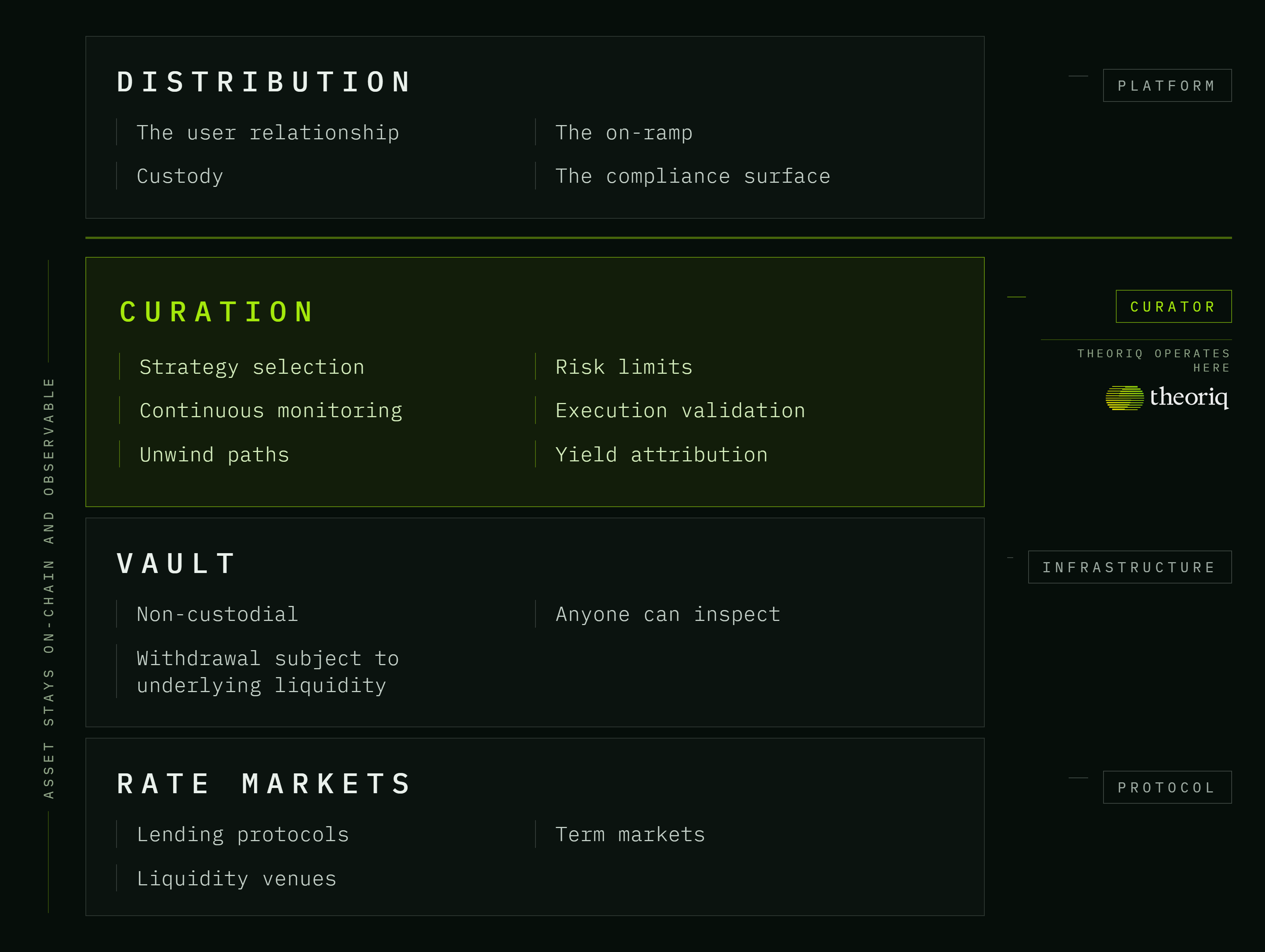
Because the stack is composable, it is contestable. Every layer can be swapped: curators compete on net-of-risk performance and how legible their process is, infrastructure on vault primitives and integration cost, distributors on the balances they bring.
Building the curation layer in-house is not adding a feature to a brokerage. It is standing up a risk-management business inside one, from a standing start.
Earn does not stop at stablecoins
The asset base is expanding faster than the products built on it.
Stablecoins lead and will keep leading. ETH and BTC follow, with liquid staking tokens, restaked positions, and yield-bearing wrappers now deep enough in on-chain credit to support real size. Behind them, liquid real-world assets are arriving as collateral: tokenized commodities, short-dated treasuries, and money market funds, each with a native yield, an identifiable issuer, and a redemption path.
The numbers are no longer small. Tokenized real-world assets excluding stablecoins reached roughly $31 billion by May 2026, with Treasuries and money market funds about $10 billion of that, up from under $1 billion two years earlier. Tokenized gold crossed $6 billion, up about 450 percent in twelve months. Nor are they idle: Deribit and Crypto.com accept BlackRock's BUIDL as derivatives collateral, Binance institutional clients can post Circle's USYC, and in December 2025 the CFTC issued guidance permitting tokenized Treasuries and money market fund shares as collateral for futures and swaps.
The sources of yield are widening alongside them: lending and term markets, basis and funding strategies, staking and restaking, liquidity provision, structured credit, and now RWA-backed fixed income. For a distributor, that abundance is noise. Nobody underwrites thirty venues while running an exchange. For a curator it is the opportunity: room to build portfolios that are genuinely diversified, to rotate as spreads compress in one venue and open in another, and to size against liquidity rather than advertised APY.
It is also where curators separate from one another, in the return series and in what happened during the last dislocation.
From trading venue to digital wealth platform
For exchanges that are here to stay, the strategic version of this is not adding an earn tab. It is adding a digital wealth management service layer on top of the venue.
The pieces are already in hand: the account, custody, the compliance surface, a KYC'd user base, and an asset set spanning stablecoins, majors, and tokenized real-world instruments. What is missing is the layer that turns holdings into allocations, with a stated risk profile, an attribution report, and a defined path out.
That is a wealth business. It monetizes assets under management rather than turnover, deepens with time rather than decaying with it, and survives a bear market because a balance sheet still needs managing when nobody is trading. The distributor keeps the customer and the surface, the curator supplies the investment discipline, risk enforcement, and reporting. Neither side has to become the other.
Where Theoriq comes in
Two vaults are live today, open for deposits at theoriq.ai. AlphaVault ETH curates ETH-native yield as a vault-of-vaults, denominated in ETH. Theoriq Gold Vault applies the same framework to tokenized gold on XAUt, so a gold holder earns without changing what they hold. Neither of the vaults took a principal loss since launch, and both have posted positive returns in every month of operation in 2026. That rests on enforcement rather than after-the-fact judgment: every proposed transaction is evaluated by a quorum of trusted execution environments and simulated against the live portfolio before it can execute.
More collateral types are close behind. A money market fund token anchored vault launches later this month, with further liquid real-world asset vaults in the pipeline and a fixed-income pilot in progress alongside a leading licensed digital asset infrastructure platform.
The same stack can sit behind someone else's front end. Theoriq is built to power earn and yield vaults for exchanges, fintech apps, custodians, and asset issuers. You keep the customer, the interface, and the compliance surface. We supply the strategy, the risk limits, the monitoring, and the attribution, in whatever denomination your users already hold.
The asset changes. The discipline transfers.
Building an earn program, a wealth layer, or bringing a tokenized asset to market? Get in touch: business@theoriq.ai
About Theoriq
Theoriq builds the risk and yield intelligence layer for tokenized markets. It turns tokenized assets into risk-managed yield through multi-asset and infra-agnostic DeFi vaults: curators set the strategy and the risk limits, and AI-assisted systems execute and monitor within them. Its flagship vault, AlphaVault ETH, applies this framework to ETH-native yield, and the Theoriq Gold Vault extends it to tokenized gold, with plans to extend the model to additional real-world assets. Learn more at theoriq.ai.