


Theoriq Monthly Vault Report Summary: August 2026
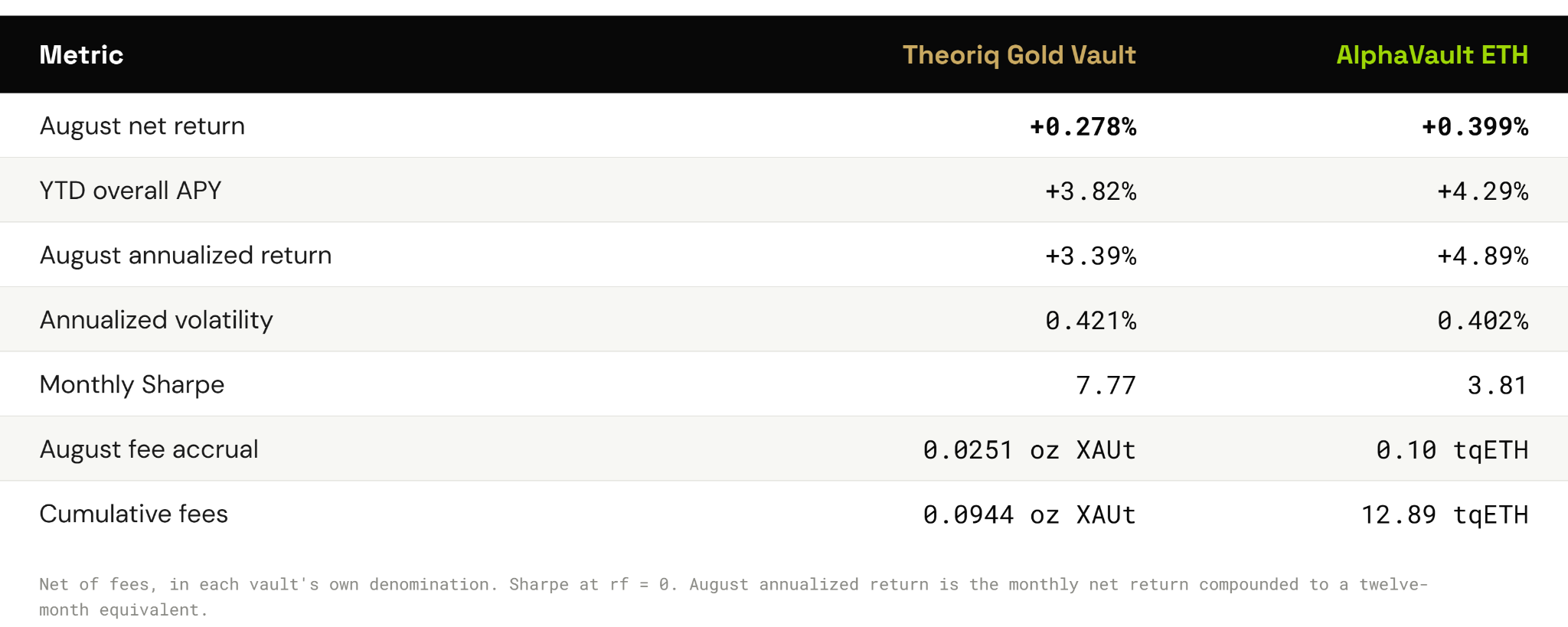
August was a month of strong markets and disciplined returns. Both live Theoriq vaults closed positive in their own denomination: the Theoriq Gold Vault returned +0.278% in gold terms, about +3.39% annualized, and AlphaVault ETH +0.399% in ETH terms, about +4.89% annualized, with year-to-date overall APY at +3.82% for tqGOLD and +4.29% for tqETH. Gold and ETH also both rallied hard on the same macro impulse in spot prices, making the base collateral a good asset to hold.
August was the first real stress test of the diligence system. Our AI-assisted monitoring flagged a deteriorating credit position, the system exited it before the deterioration could compound, and the execution costs and lower leverage that followed are the visible price of acting on risk early rather than late. Much of the month's engineering went into making that kind of action faster and more automatic, work detailed in the Risk Management & Diligence section later in the report.
The sections below open with the market context for each vault, then move through performance, revenue, and strategy, with the infrastructure that spans both vaults, including a full account of the credit event, in a section of its own.
AT A GLANCE · AUGUST 2026
Theoriq Gold Vault
MARKET CONTEXT
Gold's rally was one side of August's macro move; here is what it did and did not mean for the vault.
Gold's August rally, and what the vault measures. Gold rose sharply in August, gaining roughly 13% in US dollar terms to close near $4,560 an ounce, one of its strongest months in a quarter century. The move was driven by renewed concern over US fiscal debasement, as federal debt crossed $40 trillion and the Treasury expanded its bond buybacks, alongside a weaker dollar and record central-bank and ETF demand, before a hawkish Jackson Hole address late in the month capped the advance. For the Theoriq Gold Vault, that price action is backdrop rather than performance: the vault's return is measured in gold, so its performance represents growth in the gold denomination itself, not a view on gold US dollar price.
The tokenized gold market and its distribution. Tokenized gold continued to expand as an asset class. The total tokenized-gold market stands at roughly $4.8 billion, the large majority of all tokenized commodities, with Tether Gold (XAUt) remaining the largest single product at around $2.7 billion. Onchain retail distribution stays concentrated on Celo, where the omnichain XAUt0 form holds more than 90% of unique holders and reaches end users through Opera's MiniPay wallet. That is the ecosystem the vault sources its gold-denominated carry from.

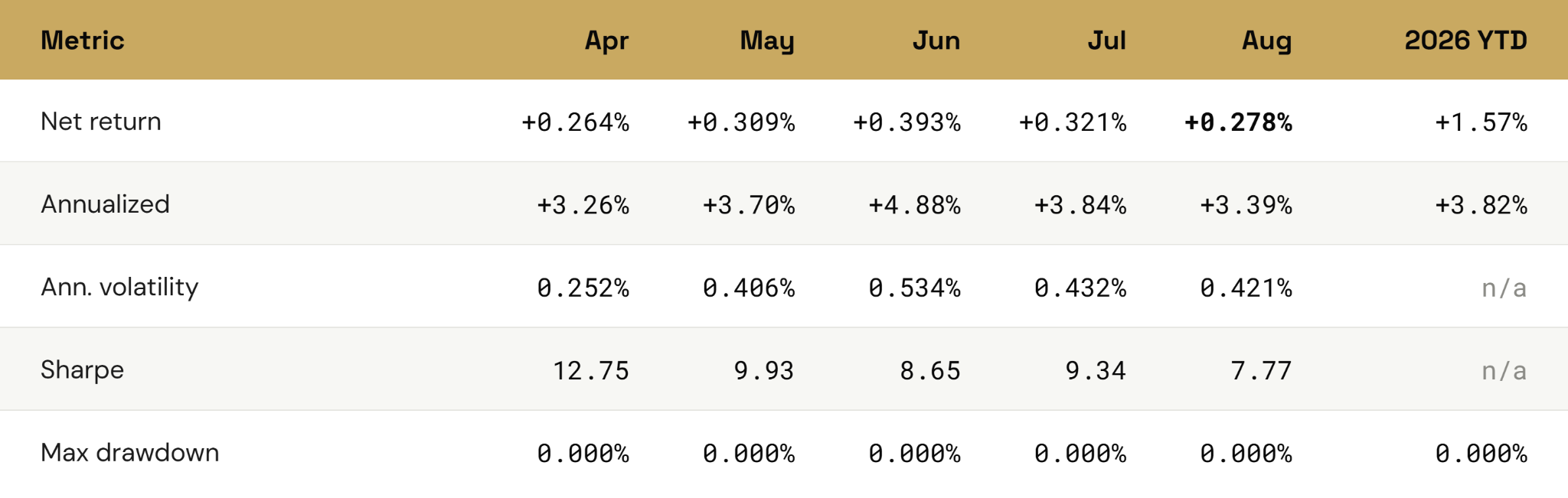
Figures are net of fees and denominated in gold (XAUt). Gold's available full-month return history begins in April. The August annualized return is the monthly net return compounded to a twelve-month equivalent, (1 + monthly return)^12 − 1. YTD overall APY is a separately reported metric, and a cumulative figure computed from rounded monthly returns may differ slightly from the underlying LP-price series.
PERFORMANCE
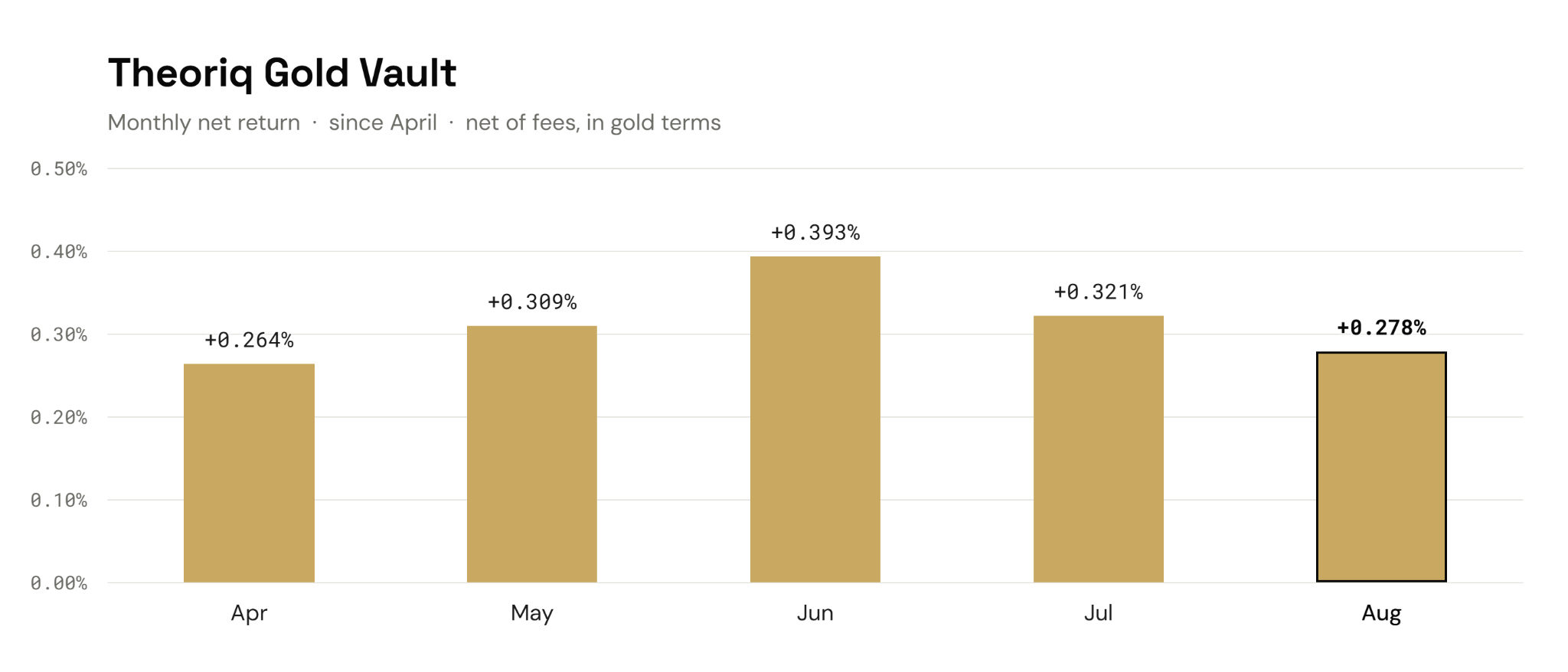
August returned +0.278% in gold terms, compared with +0.321% in July. That annualizes to about +3.39%, annualized volatility eased to 0.421%, and the Sharpe ratio was 7.77. Compounding the displayed monthly returns from April through August gives a cumulative net return of approximately +1.57%, on top of the underlying gold denomination. The year-to-date overall APY stands at +3.82% for tqGOLD.
REVENUE
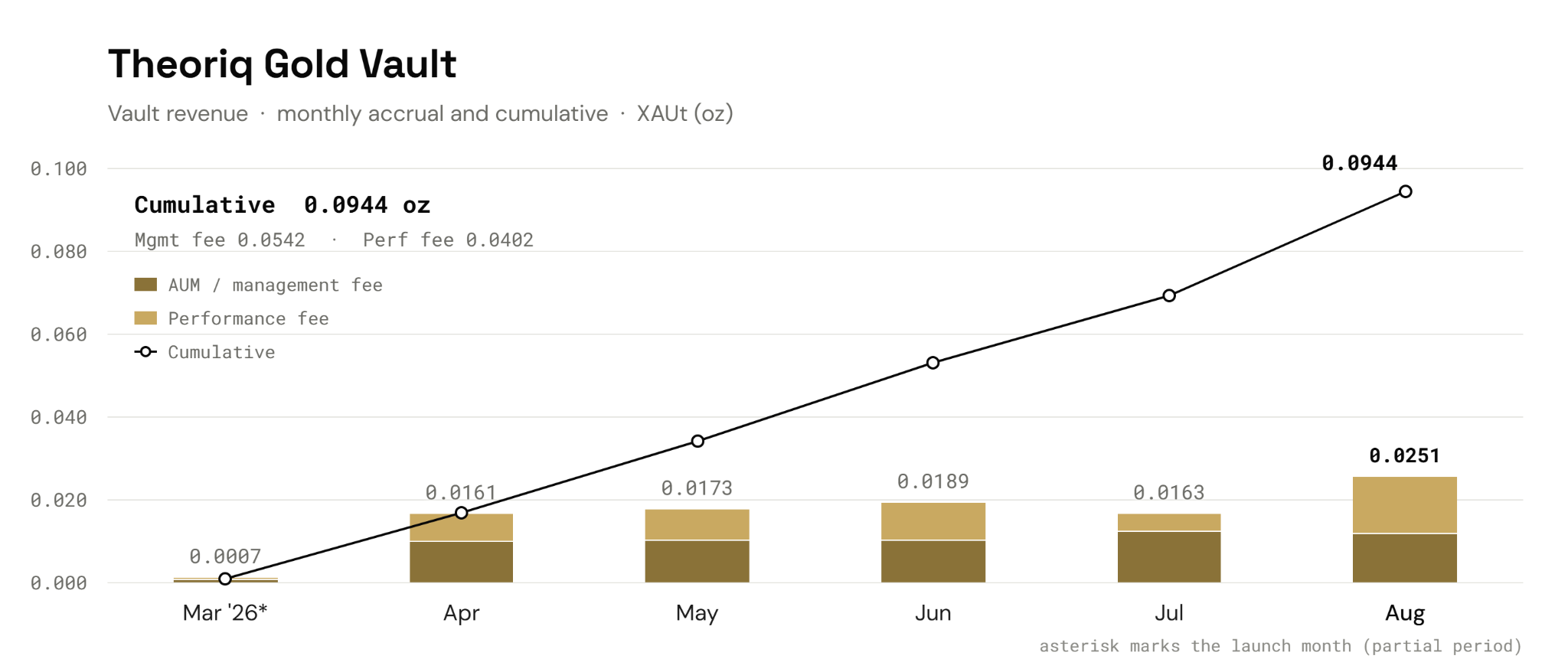
August fee accrual was 0.0251 oz XAUt, bringing cumulative revenue since the March launch to 0.0944 oz: 0.0542 from management fees and 0.0402 from performance fees. Monthly fee accrual increased from 0.0163 oz in July.
STRATEGY UPDATES
The diversified Pendle principal-token book established in July carried into August, and SIERRA was rolled over in early August at terms consistent with the prior tenor. August's softer return in gold terms came mainly from the flagged credit-position exit and from lower leverage held while a replacement was assessed and approved. The surveillance, exit, and re-approval behind that sequence are detailed under the Risk Management & Diligence section further below.
AlphaVault ETH
ETH caught the same updraft as gold, and the same distinction applies.
MARKET CONTEXT
ETH's August surge, and what the vault measures. ETH rallied hard in August, rising roughly 32% to trade back above $2,400, its strongest month in over a year and a second straight month of recovery. The move tracked the same fiscal-debasement backdrop that lifted gold, amplified by a sharp short squeeze mid-month and by sustained ETF demand. As with the Theoriq Gold Vault, that price action is separate from what AlphaVault ETH earns: the vault measures performance in ETH, so its return reflects yield generated in ETH terms rather than the change in ETH's US dollar price.
Record staking participation, and a compressed base yield. Beneath the price move, the native ETH yield picture tightened further. Staking participation set a fresh record just under 34% of supply, and with issuance fixed the base staking yield compressed to around 2.66%, extending the trend described in July's report. US spot ETH ETFs meanwhile drew roughly $1.75 billion over the month, their strongest showing in a year, adding to the demand pulling ETH out of liquid supply. For a vault that draws on credit, fixed-yield, and cross-venue positions in addition to the native staking base, a compressing base yield is precisely the condition its diversified approach is built for.

Figures are net of fees and denominated in ETH. The August annualized return is the monthly net return compounded to a twelve-month equivalent, (1 + monthly return)^12 − 1. YTD overall APY is a separately reported metric, and a cumulative figure computed from rounded monthly returns may differ slightly from the underlying LP-price series.
PERFORMANCE
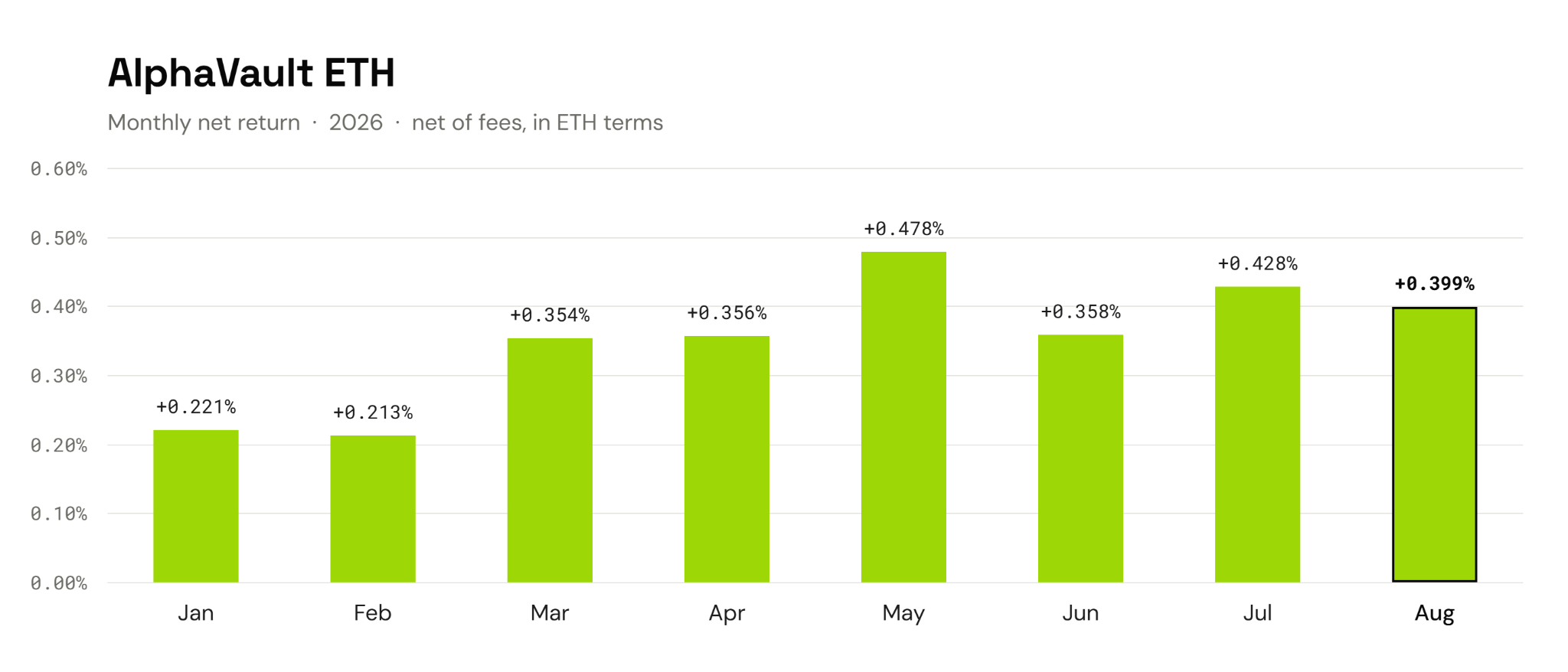
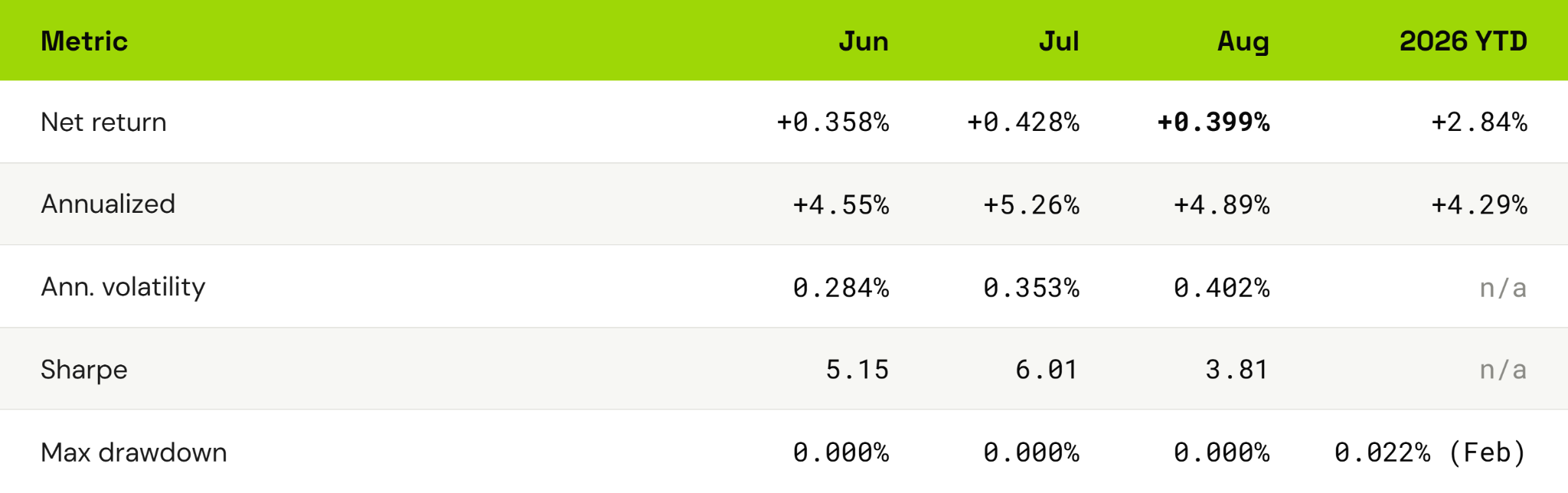
August delivered +0.399%, easing from July's +0.428%, equivalent to about +4.89% annualized. Compounding the displayed January to August monthly returns gives an approximate year-to-date net return of +2.84%; the year-to-date overall APY stands at +4.29% for tqETH. Annualized volatility increased to 0.402% from 0.353%, and the monthly Sharpe ratio was 3.81. August maximum drawdown was reported as 0.000%.
REVENUE
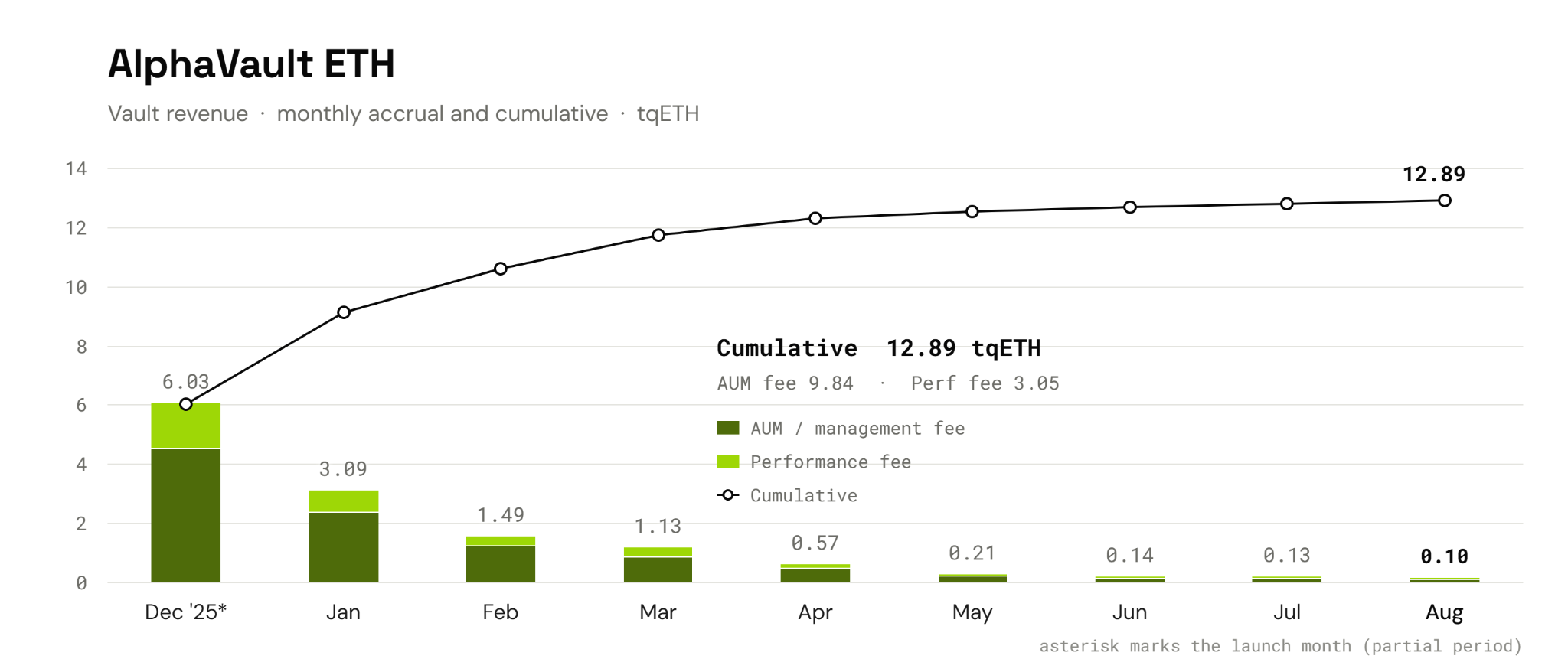
August fee accrual was 0.10 tqETH, bringing cumulative revenue since December 2025 inception to 12.89 tqETH: 9.84 from the AUM fee and 3.05 from the performance fee. The monthly accrual eased from 0.13 tqETH in July.
STRATEGY UPDATES
AlphaVault ETH ran the same diversified credit book under the same position-health monitoring and pre-entry diligence. Its return reflected the same flagged credit-position exit and more conservative leverage, and despite that drag the vault stayed positive and extended its run of monthly returns above +0.35%. The event and the subsequent re-allocation are detailed in the section below.
Risk Management & Diligence
One risk and diligence process sits beneath both vaults, spanning continuous monitoring of live positions, the venues and pipeline it runs on, and the infrastructure being built to run it. In August it was tested in earnest and extended in several places.
Continuous position monitoring. We continually monitor position health across all whitelisted RWA protocols. The diligence system combines counterparty reporting, collateral and structural analysis, stress testing, and liquidity assessment with ongoing surveillance of approved exposures. Entry approval is the start of that process; subsequent changes in collateral coverage and position health continue to inform escalation and sizing decisions.
3Jane Lendswift escalation. During August, the warehouse-lending portion of the portfolio through 3Jane Lendswift reached a watch warning as over-collateralization fell to the 33% threshold, the warehouse "equity" cushion referenced under the 3:1 warehouse agreement. Our due diligence agent classified the breach as SEV-1, triggering an unwind of the PT position. On the tooling side, a read-only position monitor now collects assets and liabilities by chain, vault, protocol, and token on a continuous cadence, records each observation for anomaly detection, and feeds an escalation layer that classifies breaches by severity.
Portfolio impact. The unwind incurred taker fees and slippage and realized the effect of the PT token's market-price movement. A principal token behaves like a zero-coupon bond: for a given redemption value and maturity, a higher market yield implies a lower price. Selling before maturity therefore exposes the position to that price change as well as execution costs. The resulting drag was compounded by lower overall leverage while new opportunities were evaluated.
New allocation after diligence. Later in August, nOPAL passed diligence and the September 16 position was entered in both vaults. The sequence illustrates how surveillance, escalation, exit, and approval of new opportunities operate within the same diligence process.
Venue and RWA evaluation. The evaluation framework continues to prioritize senior positioning, measurable subordination, collateral transparency, short collateral duration, and full structural documentation. Aave v4 and Midnight received permissions at the end of July; permissioning remains distinct from a decision to commit capital. Feather on Celo provides an additional borrowing route specific to the Theoriq Gold Vault, with oracle behavior and liquidation mechanics central to its risk assessment.
Execution automation and venue expansion. A meaningful part of August's engineering effort went into execution infrastructure that does not show up in the P&L yet but underpins what follows. We deployed our own Hyperliquid node in Tokyo, co-located with the exchange, which gives us a direct, independent view of the venue's state rather than the public data feed and lets us measure precisely how quickly an order reaches the chain. On the automation side, we built a two-venue quoting and hedging engine spanning Lighter and Hyperliquid: a position taken on one venue is automatically offset on the other, with a separate parameter service that tunes the engine as conditions change. It has been exercised live at small size. On Lighter, we confirmed a zero-fee market structure across more than two hundred markets and mapped where the genuinely profitable opportunities sit, several of them unavailable to participants still paying standard fees.
Bundled execution. We also completed the core of the execution framework that moves both vaults from hand-assembled, leg-by-leg transactions to atomic bundled execution. A multi-step action, approve, supply, borrow, swap, unwind, is now composed into a single transaction through an owner-gated executor, and each bundle reads live on-chain state at execution time so it stays valid even if conditions move between construction and submission. Every bundle runs the same checks as a single transaction: it is simulated and policy-checked against the custodian before signing, then independently decoded and verified against the protocol whitelist before approval. Position exit is a first-class action in this framework, expressed as one bundle, repay, withdraw collateral, swap to base asset, return to vault, rather than a manually approved sequence.
Active blow-up risk modeling. We are extending the monitor from position-level health checks to an active model of how losses propagate. For each exposure, it estimates the probability and severity of impairment at the protocol layer (contract, oracle, governance, or venue failure) and at the collateral layer (underlying-asset depeg, warehouse or counterparty deterioration, liquidity withdrawal), and how a shock in one layer transmits to the others and to the rest of the book. The output is intended to drive position sizing and pre-committed exit thresholds directly, so escalation is set ahead of time rather than decided under stress. This work is in progress.
Conclusion
August tested both halves of what these vaults are built to do. Each stayed positive in its own denomination through a month when its collateral moved sharply in dollar terms, and the month also produced what a run of clean months cannot: a real position deteriorating in real time, met with the response the system is built for. The 3Jane Lendswift exit was not costless, but the alternative is not seeing the deterioration in time, or seeing it and holding a thinning position in the hope it recovers, which is precisely what the diligence process exists to prevent.
Much of August's work went where it does not yet show in the numbers: an execution framework that turns a multi-step unwind into a single, pre-checked action, direct venue infrastructure, and an active model of how losses would propagate across a position. Watching surveillance, escalation, exit, and a new approval run inside one process says more about how this capital is managed than any single month's return, and that process is being built to act earlier and more automatically over time.
Going into September, the newly approved nOPAL position is live in both vaults, venue access is permissioned, and the tokenized-credit pipeline continues under the same bar, with continuous surveillance across every exposure at the center of it.
About Theoriq
Theoriq builds the risk and yield intelligence layer for tokenized markets. It turns tokenized assets into risk-managed yield through multi-asset and infra-agnostic DeFi vaults: curators set the strategy and the risk limits, and AI-assisted systems execute and monitor within them. Its flagship vault, AlphaVault ETH, applies this framework to ETH-native yield, and the Theoriq Gold Vault extends it to tokenized gold, with plans to extend the model to additional real-world assets. Learn more at theoriq.ai.