Theoriq Quarterly Vault Report: Q3 2026


Third Quarter 2026 | Theoriq Gold Vault and AlphaVault ETH | July 1 to September 30, 2026
The third quarter asked more of both Theoriq vaults than any period since launch. Gold rallied in August and gave most of it back in September, ETH climbed in all three months, native staking yield kept compressing, and in August the diligence system flagged a credit position and exited it. Both vaults closed every reported month positive in their own denomination.
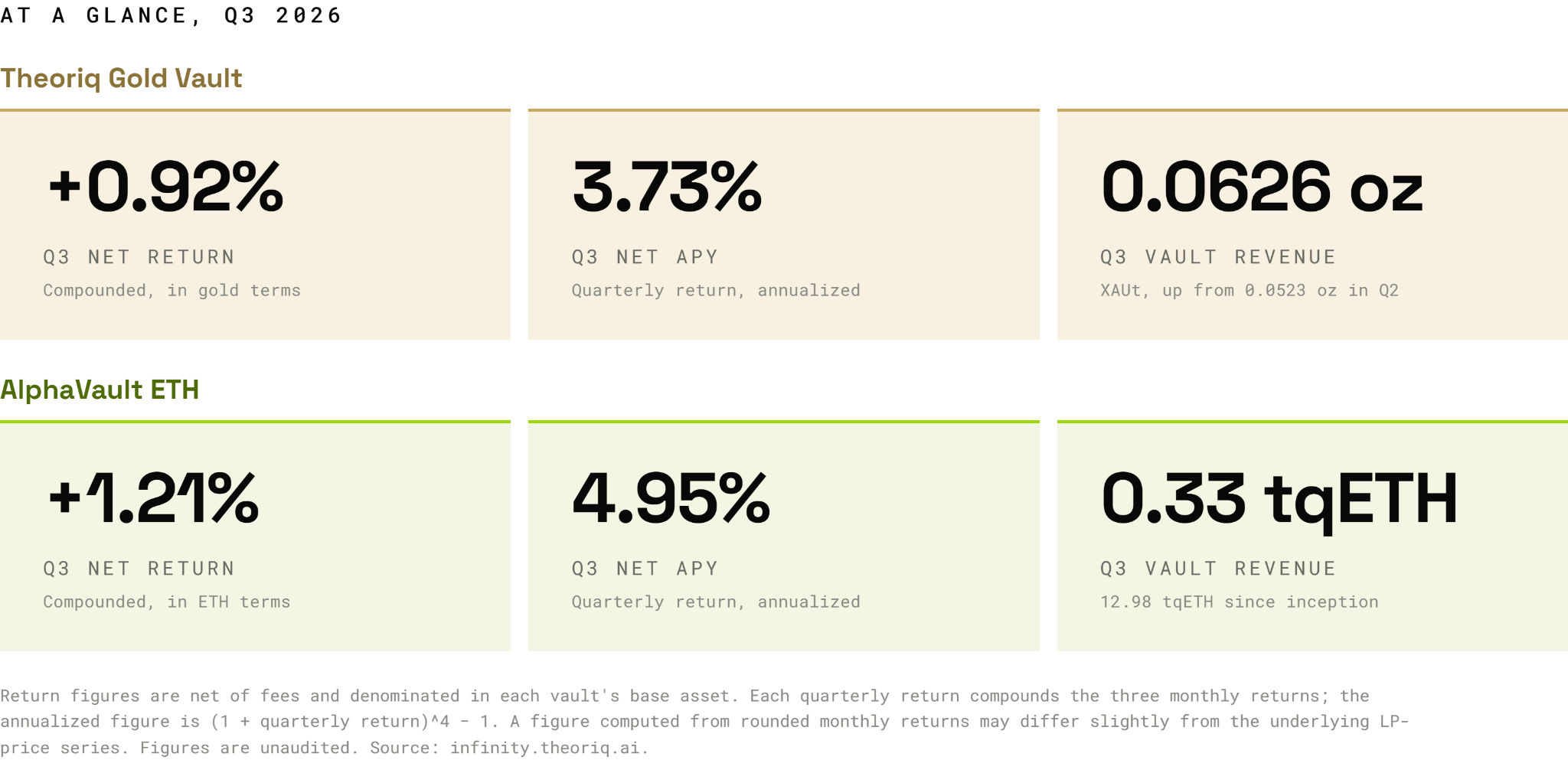
Because the vaults earn in the assets they hold, returns are measured in those assets rather than in dollars. Theoriq Gold Vault returned +0.92% for the quarter in gold terms, about 3.73% annualized. AlphaVault ETH returned +1.21% in ETH terms, about 4.95% annualized.
Three developments shaped the quarter. A diversified book of Pendle principal tokens replaced a narrower set of carry trades in July. The diligence system flagged a warehouse-lending exposure in August and exited it at a known cost. Execution then moved from hand-assembled transactions toward atomic bundles that are simulated and policy-checked before signing. Because the two vaults share most of this activity, it is described once, in the sections on allocation, operations, and risk. The vault sections cover what is specific to each.
Allocation Changes in Q3
Entering the quarter, both vaults earned mainly from lending spreads across venues and chains, with Pendle positions as a smaller, growing sleeve. By the end of July, fixed-yield credit had become a core allocation. August then forced a reduction and a replacement.
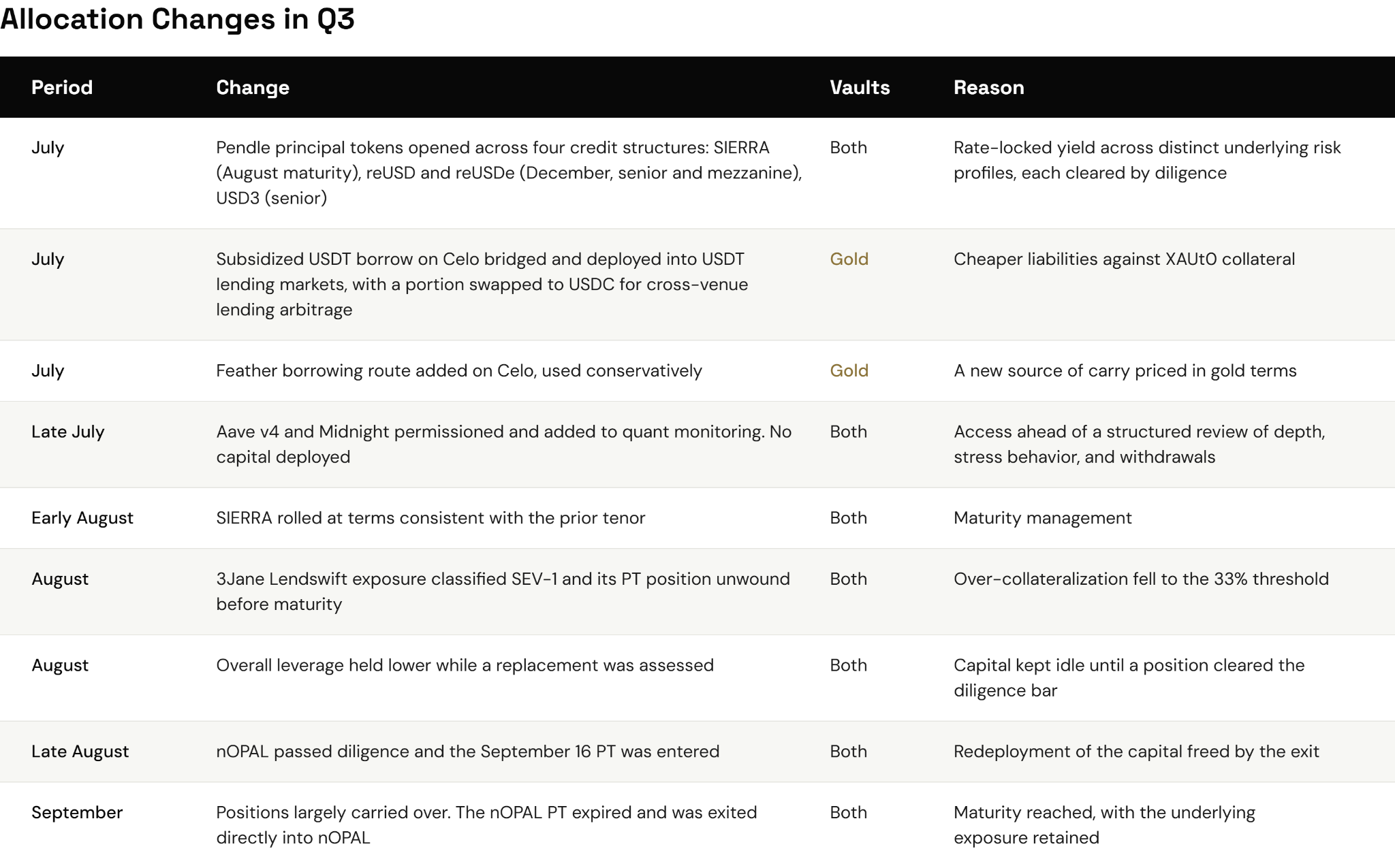
From spread capture to fixed yield. July's entries changed how the vaults earn. Lending arbitrage pays a floating spread that can close within days. A principal token locks its yield at purchase and pays it at maturity, so the return is known on entry provided the underlying credit performs. Spreading that exposure over backed stablecoins, real-world asset structures, and a credit money market meant no single issuer carried the fixed-yield sleeve.
Seniority by design. Where a structure offered tranches, the vaults took senior and mezzanine positions in reUSD and reUSDe and a senior position in USD3. Maturities were staggered between August and December, which kept part of the book rolling off each month and available for redeployment.
The August reduction. The exit from the 3Jane Lendswift exposure was the quarter's largest single allocation change. A principal token behaves like a zero-coupon bond, and selling one before maturity means accepting the market price of the day along with taker fees and slippage. That cost landed in August's return for both vaults. Leverage stayed lower for the weeks that followed, which reduced carry further.
Redeployment. The freed capital sat until a candidate passed the same process that had triggered the exit. nOPAL cleared it late in August, and the position was entered in both vaults. September brought no further rotation. When the nOPAL PT expired mid-month, both vaults moved from the expired PT directly into nOPAL and kept the exposure. The full account of the credit event appears under Risk Management and Diligence.
Theoriq Gold Vault
Market Context
Gold opened the quarter in the low $4,000s after a six-month retracement from its January high near $5,600. July closed at $4,049, up about 0.9% and the first positive month since February, once the Federal Reserve held rates steady. August was far stronger. The metal climbed to a high near $4,638 as federal debt crossed $40 trillion, the Treasury expanded its buybacks, and the dollar weakened. A hawkish Jackson Hole address late in the month pulled it back, and gold closed August near $4,430, up roughly 9%.
The tokenized gold market grew alongside the price. It stood near $4.8 billion in August, with Tether Gold the largest product at around $2.7 billion. Tether disclosed another 14 tonnes of physical gold added in the second quarter, taking its holdings past 146 tonnes. Retail distribution stayed concentrated on Celo, where XAUt0 holds more than 90% of unique tokenized gold holders and reaches users through Opera's MiniPay wallet, which crossed 18 million users in July.
September reversed part of that advance. On September 16 the Federal Reserve raised rates by 25 basis points to a 3.75% to 4.00% target range, its first hike since 2023, and signaled that further tightening could follow. The dollar climbed to a high of nearly a year and a half, the 10-year Treasury yield rose to about 5.3%, and Brent crude moved above $100. Gold fell about 6% on the month, its weakest since June, and closed near $4,155 an ounce. Reported buying from central banks and ETFs continued through the selloff. For the vault, the month was a useful contrast with August: gold fell in dollar terms and the vault still added +0.319% in ounces.
Performance
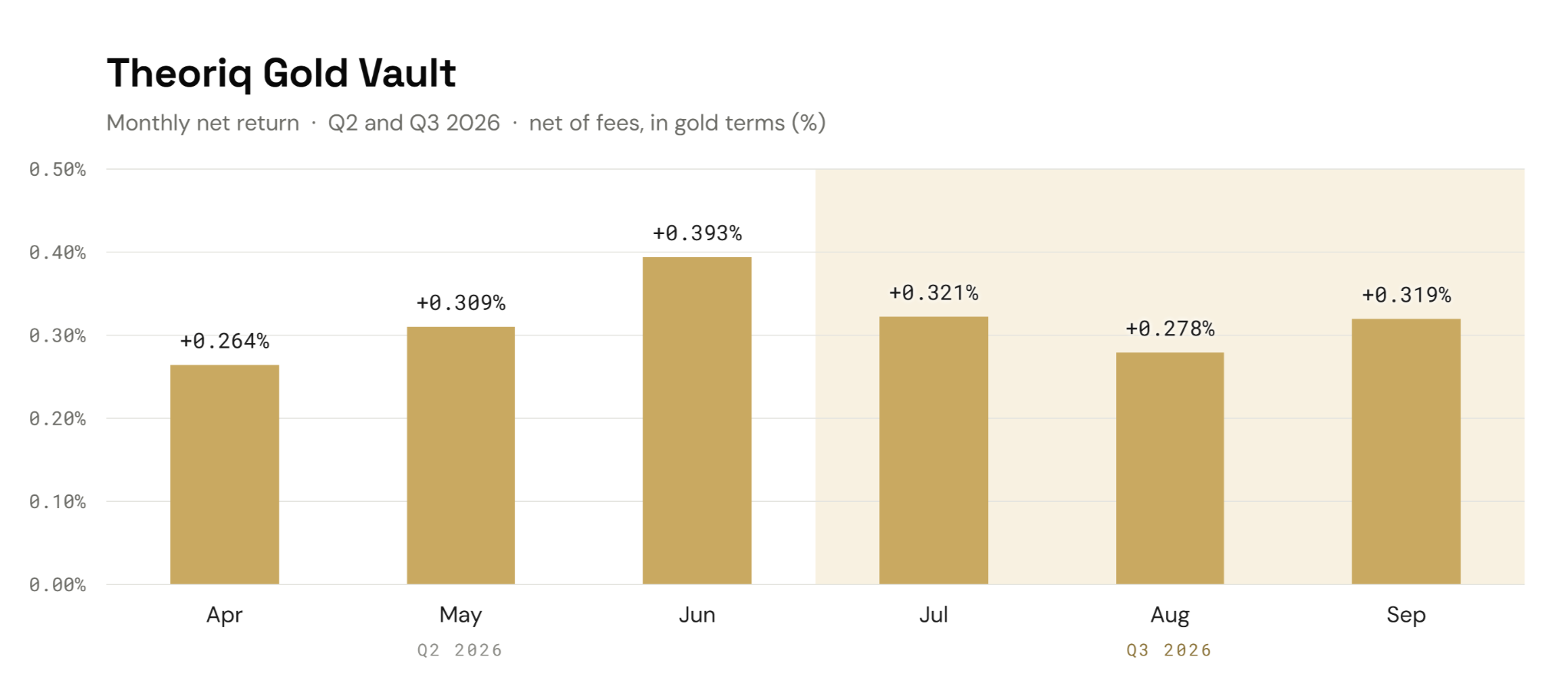
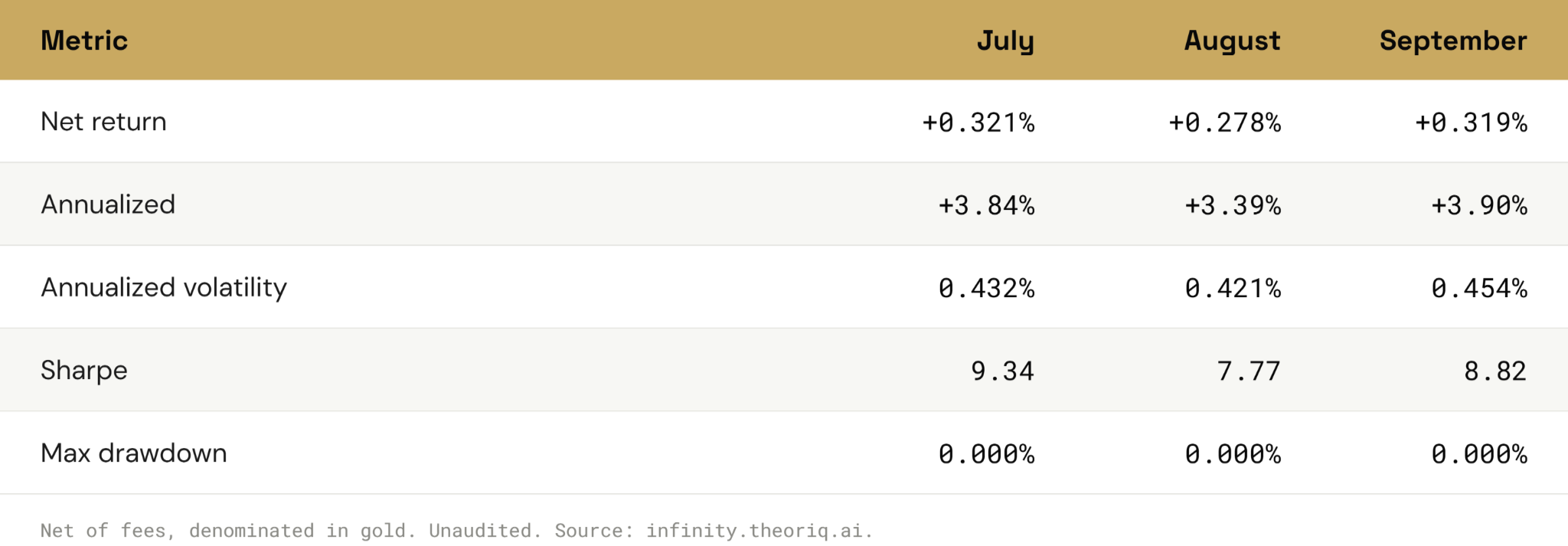
The vault returned +0.92% for the quarter, or about 3.73% annualized. That compares with +0.97% in the second quarter. Nearly all of that gap traces to August, when the credit exit and lower leverage pulled the month to +0.278%. September recovered to +0.319%, close to July's level, with volatility at 0.454% and a Sharpe ratio of 8.82.
Six full months of history now exist. Each one has been positive, inside a band of +0.264% to +0.393%. Compounding April through September gives a cumulative net return of approximately +1.90%, earned in ounces on top of the gold holding itself.
Revenue
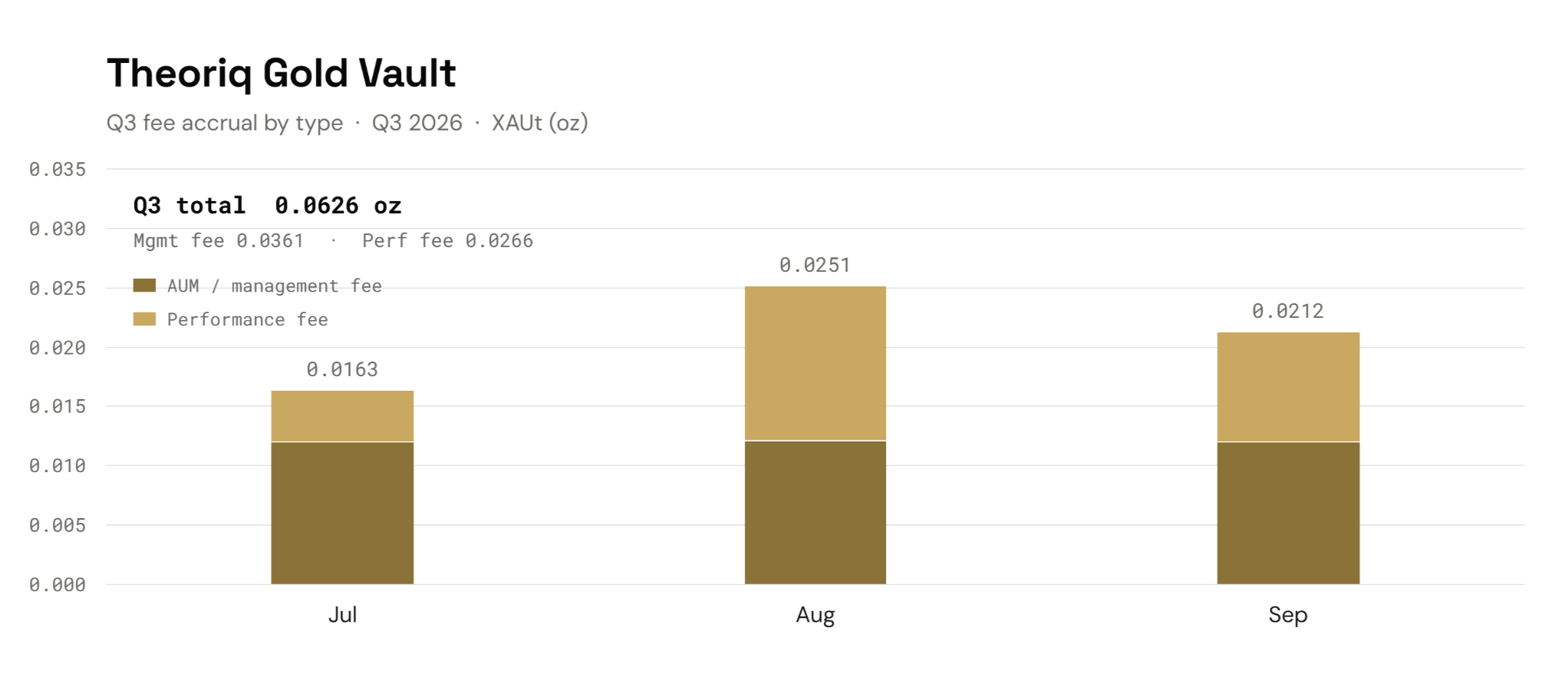
Fee accrual for the quarter was 0.0626 oz XAUt, about 20% above the second quarter's 0.0523 oz. Management fees contributed roughly 0.0361 oz and performance fees 0.0266 oz. Cumulative revenue since the March launch reached 0.1156 oz at September 30: 0.0662 oz from management fees and 0.0495 oz from performance fees.
The monthly pattern is worth a note. Management fees held near 0.012 oz each month, so the swings came from performance fees, which were lowest in July and highest in August. Performance fees settle against the high-water mark and their timing does not line up neatly with the calendar month in which the return was earned.
Vault-Specific Positioning
Two things are specific to the gold vault, and both lower what it costs to fund the book. The first is a Celo liability stack: USDT borrowed cheaply against XAUt0, bridged cross-chain, and lent out for spread, with a portion swapped into USDC for the cross-venue arbitrage. The second is Feather, a Morpho fork on Celo that offers a lower borrow rate against XAUt0 and sits in the same ecosystem as most tokenized gold holders. Feather use stayed conservative while its oracle and liquidation behavior were watched across market conditions.
AlphaVault ETH
Market Context
ETH ended June near $1,558 after six consecutive monthly losses. July reversed that with a gain of about 23% to roughly $1,916, helped by the Fed's hold and $365 million of spot ETF inflows. August added roughly 28% and took the price back above $2,400, driven by the same fiscal backdrop that lifted gold, a mid-month short squeeze, and about $1.75 billion of ETF demand.
Yield moved the other way. Staking participation set records near 34% of supply in July and August. With issuance fixed, the base staking yield fell from around 2.8% in July to about 2.66% in August. A vault that earns from credit, fixed-yield, and cross-venue positions alongside staking is built for that condition, and its returns ran well above the staking base in every month of the quarter.
ETH extended its recovery for a third month, gaining 8.77% in September, its best September since 2016. Price reached about $2,800 on September 21, the highest level since January, before pulling back late in the month. US spot ETH ETFs took in roughly $832 million, about half of August's total, and the month ended with a day of outflows across all ten funds. The rally held through the Fed's September 16 rate hike, which weighed on gold and bonds. Staking participation rose again to roughly 35% of supply, and the base staking yield slipped to between 2.5% and 2.6%. AlphaVault ETH's +0.382% for the month annualizes to about 4.69%, well above that base.
Performance
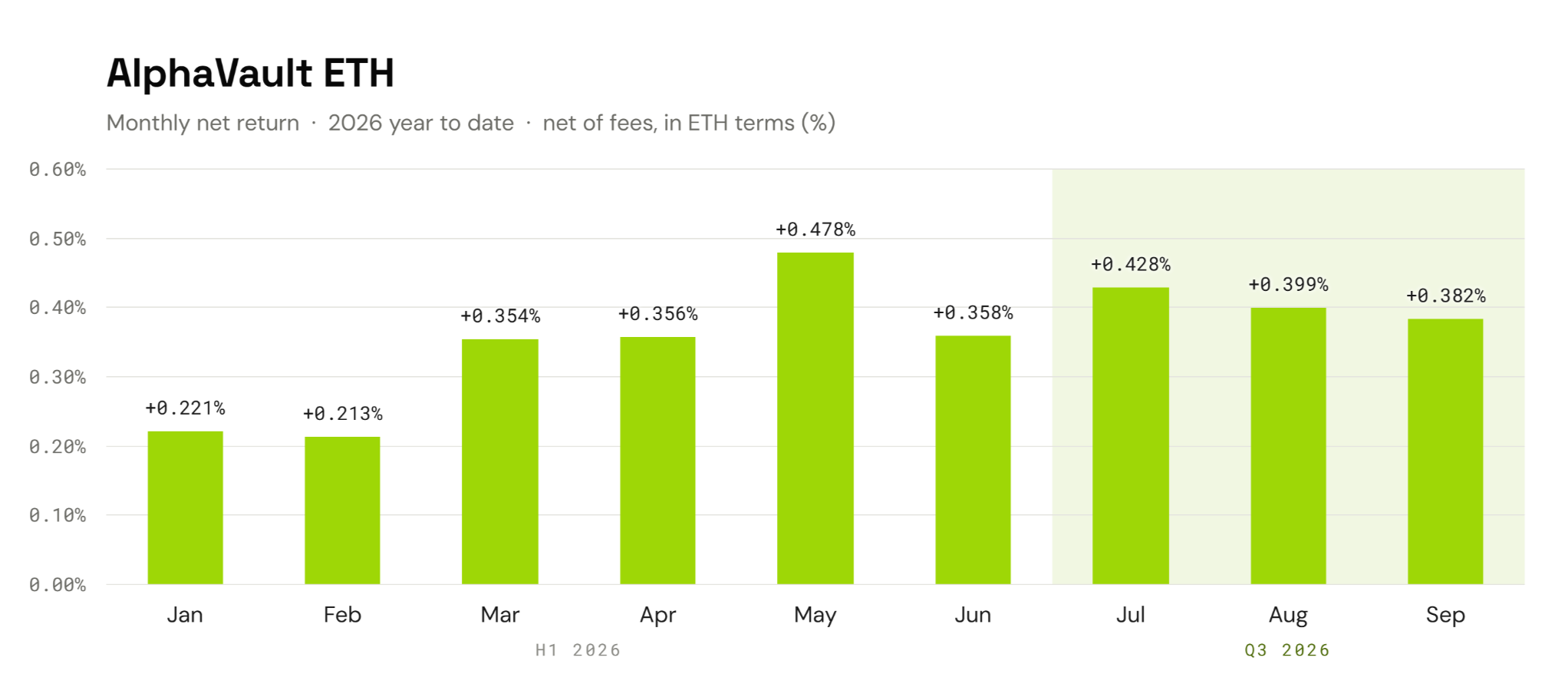
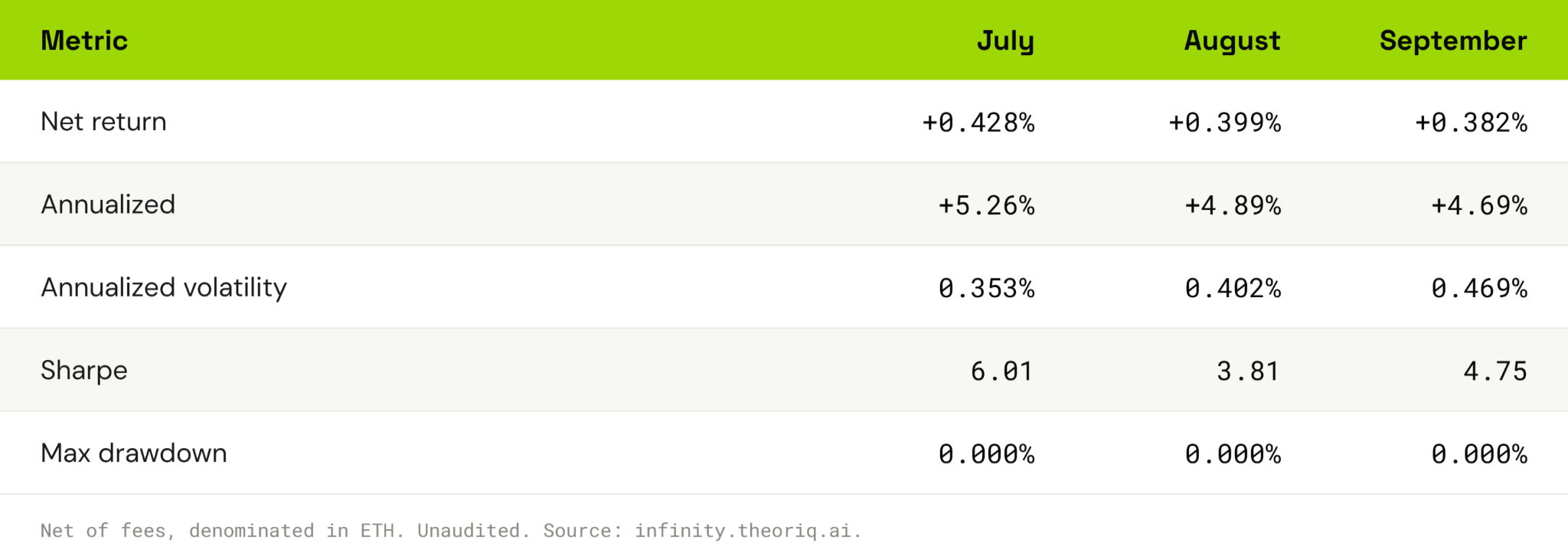
July's +0.428% was the second strongest month of the year, behind May. August eased to +0.399% as the credit exit and lower leverage took effect, and still extended the run of months above +0.35%. September added +0.382% on a book that was largely unchanged from the end of August. Compounded, the quarter returned +1.21% in ETH terms, about 4.95% annualized, against +1.20% in the second quarter. Compounding January through September gives a year-to-date net return of approximately +3.23%.
Annualized volatility rose each month, from 0.353% in July to 0.402% in August and 0.469% in September, continuing the uptick that began in June as the strategy mix broadened. The monthly Sharpe ratio was 6.01, 3.81, and 4.75. Maximum daily drawdown was 0.000% in all three months, which extends the run without a drawdown to seven months.
Revenue
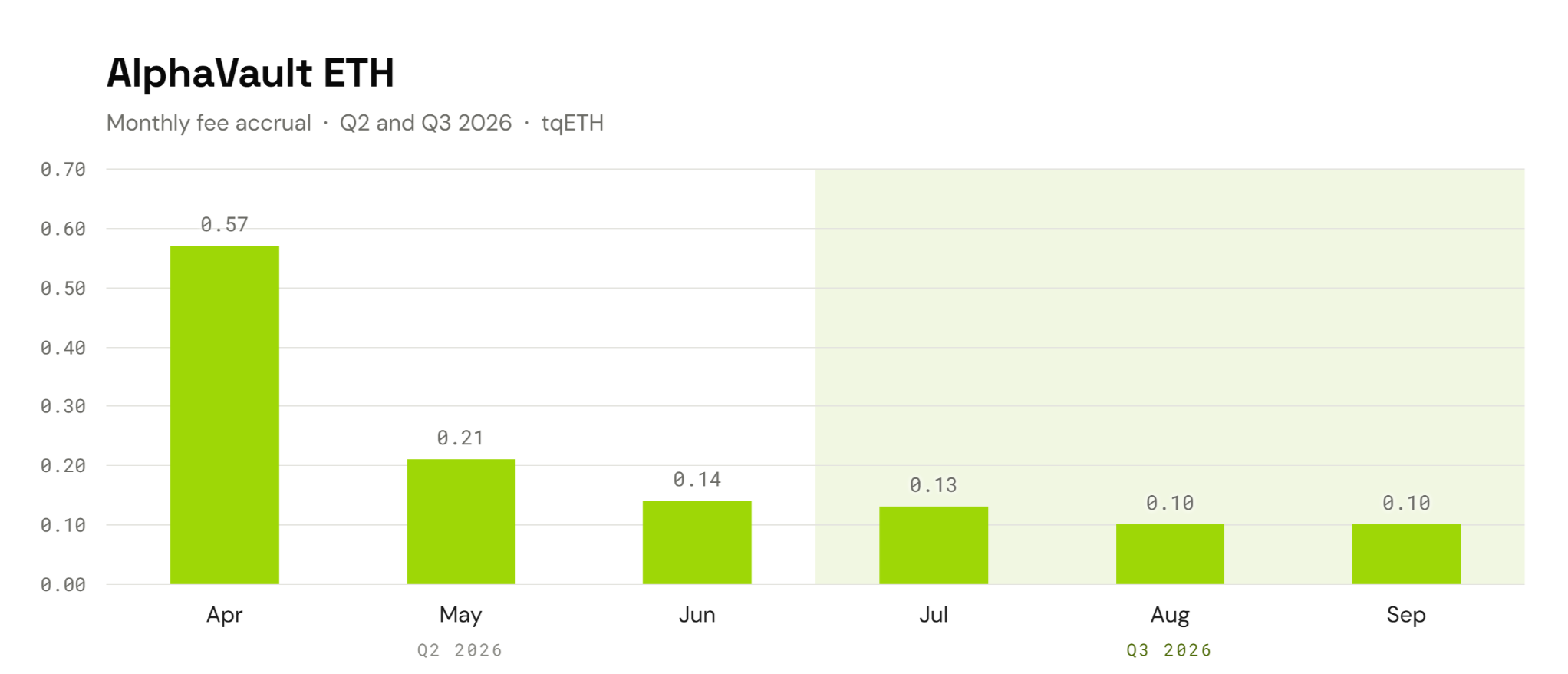
Fee accrual was 0.13 tqETH in July, 0.10 in August, and 0.10 in September, for 0.33 tqETH over the quarter. Cumulative revenue since the December 2025 inception reached 12.98 tqETH: 9.90 from the AUM fee and 3.08 from the performance fee. The monthly rate has settled well below the launch-period peaks as the fee base normalized, and it held flat from August into September.
Vault-Specific Positioning
Both vaults ran cross-venue and cross-chain arbitrage during the quarter. What AlphaVault ETH added on top was rewards farming on Morpho and Merkl programs. Private credit remains the main focus of its real-world asset research.
New Strategies Under Review
These return sources are not yet part of the book. Each is being tested at small size, researched, or reviewed, and committing capital to any of them remains a separate decision.
- Two-venue quoting and hedging (tested at small size). An engine spanning Lighter and Hyperliquid takes a position on one venue and offsets it automatically on the other. A separate parameter service tunes it as conditions change.
- Lighter market mapping (research). We confirmed a zero-fee market structure across more than two hundred markets and mapped where the profitable opportunities sit. Several are unavailable to participants paying standard fees.
- Tokenized credit pipeline (in review). Several structures are under evaluation against five requirements: senior positioning, measurable subordination, weekly collateral transparency, short collateral duration, and full structural documentation.
Q3 Operational Improvements
Most of the quarter's engineering went into how the vaults act, and little of it shows in the returns yet. The August exit made the case for the work: a multi-leg unwind assembled by hand costs time, and time is what a deteriorating position does not offer.
Bundled execution. The core of a new execution framework was completed in August. A multi-step action such as approve, supply, borrow, swap, and unwind is now composed into a single transaction through an owner-gated executor. Each bundle reads live onchain state when it executes, so it stays valid if conditions move between construction and submission.
The same checks, applied to the whole bundle. Every bundle is simulated and checked against the policy rules of the MPC signing infrastructure before signing. It is then independently decoded and verified against the protocol whitelist before approval. This sits on top of the TEE validator quorum described in the second-quarter report.
Exit as a first-class action. Leaving a position is now expressed as one bundle: repay, withdraw collateral, swap to the base asset, return to the vault. Previously each of those legs was approved manually in sequence.
Direct venue infrastructure. We deployed our own Hyperliquid node in Tokyo, co-located with the exchange. It provides an independent view of the venue's state in place of the public data feed, and it lets us measure how quickly an order reaches the chain.
Automated hedging. The Lighter and Hyperliquid engine described above has been exercised live at small size. Its purpose is to remove the delay between taking a position and offsetting it.
Risk Management and Diligence
One diligence process sits beneath both vaults. By July it covered the full lifecycle of a credit position. It ingests counterparty reporting weekly, normalizes it into a longitudinal dataset, and runs automated checks against stress scenarios calibrated on historical credit events in consumer installment, SMB, and structured-finance assets. Threshold breaches raise formal escalation flags. Entry approval is where surveillance begins.
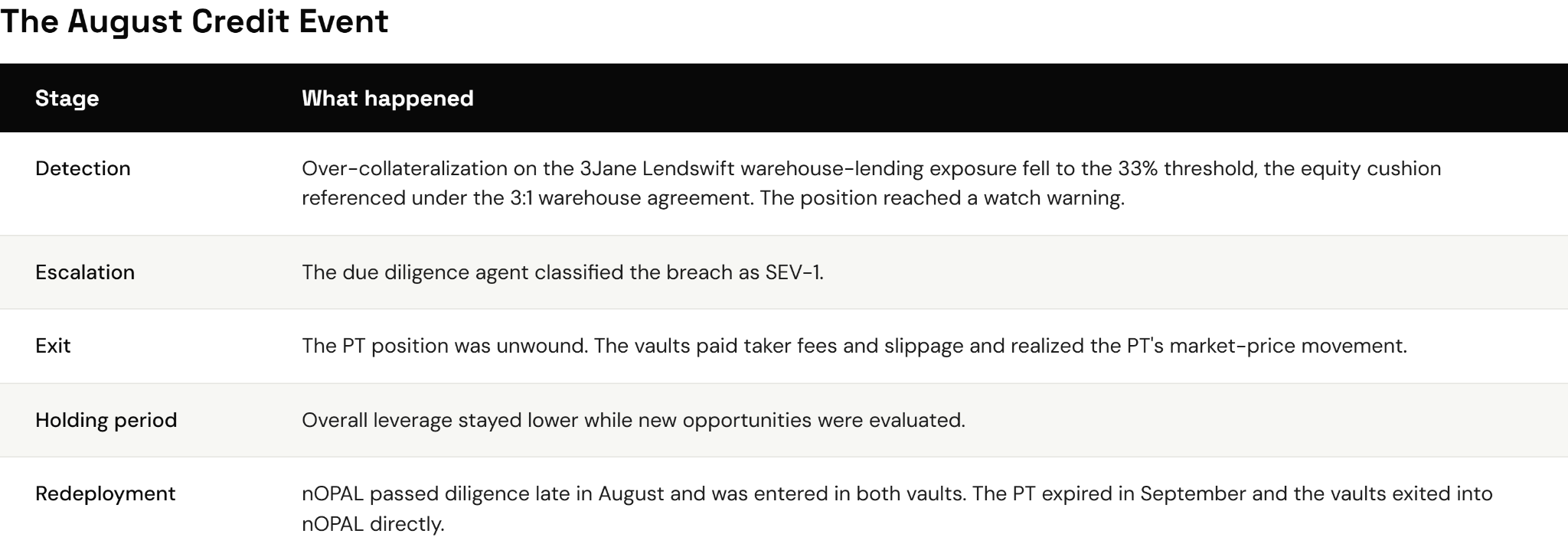
The exit had a visible price. August was the softest month of the quarter for both vaults, and each still closed positive. Holding a thinning position in the hope of recovery would have avoided the execution cost and left the vaults exposed to a larger one.
AI in the Risk Engine
- Due diligence agent. An AI agent runs the diligence process end to end. It reads counterparty reporting each week, checks every position against a library of stress scenarios, and assigns a severity level when a threshold is breached. In August it classified the 3Jane Lendswift breach as SEV-1, which triggered the unwind. People set the thresholds and the risk limits, and the agent applies them continuously.
- AI-assisted position monitor. A read-only monitor collects assets and liabilities by chain, vault, protocol, and token on a continuous cadence. Each observation is recorded for anomaly detection, and the results feed the agent's escalation layer.
- Blow-up risk modeling (in progress). The next step extends the agent from checking position health to modeling how losses spread. For each exposure it estimates the probability and severity of impairment at the protocol layer and at the collateral layer, and how a shock in one reaches the rest of the book. The output is intended to set position sizes and exit thresholds ahead of time.
Outlook
The fourth quarter opens with much of the book already committed. The reUSD and reUSDe principal tokens mature in December, returning a large share of the fixed-yield sleeve for redeployment, and where that capital goes will depend on what the pipeline has cleared by then. Aave v4 and Midnight are permissioned and monitored, each awaiting its deployment review, and bundled execution is in place for whichever entry or exit comes first.
Beyond the credit book, the plan is to scale the perpetuals sleeve on the major perp DEXs, starting with Hyperliquid and Lighter. The quoting and hedging engine has run live at small size on both, and position sizes will grow only as live results support them.
The event calendar is heavy. The US midterm elections fall on November 3, the Federal Reserve meets twice more after September's hike, and geopolitical risk remains elevated. We will watch market sentiment closely through each and are prepared to hold leverage lower around them, as we did in August, if conditions call for it.
he quarter closed with both vaults positive in their own denomination through sharp moves in their collateral and one credit position that had to be sold early. That last part is the one that matters. A stretch of clean months shows the design running. A position that goes wrong, caught and closed before it compounds, shows it working. The task now is to see the next one sooner, and to leave it faster.
About Theoriq
Theoriq builds the risk and yield intelligence layer for tokenized markets. It turns tokenized assets into risk-managed yield through multi-asset and infra-agnostic DeFi vaults: curators set the strategy and the risk limits, and AI-assisted systems execute and monitor within them. Its flagship vault, AlphaVault ETH, applies this framework to ETH-native yield, and the Theoriq Gold Vault extends it to tokenized gold, with plans to extend the model to additional real-world assets. Learn more at theoriq.ai.