AlphaVault ETH: Q1 2026 Review

This is the AlphaVault ETH Q1 2026 portfolio review: how the vault performed, what changed inside it, and where the focus sits going into Q2.
AlphaVault ETH returned 3.45% in Q1 2026, denominated in ETH, at a Sharpe ratio of 4.14 and a peak drawdown of 2.21 basis points. Theoriq’s AI-curated ETH yield vault-of-vaults closed the quarter with a portfolio that looks meaningfully different than the one that began the year.
Q1 was less about any single trade and more about the cumulative effect: the strategy universe expanded across ETH credit and Pendle markets, USD carry was integrated into the curation pipeline as a first-class strategy family, concentration in legacy ETH leverage came down, and the infrastructure for moving capital across venues and chains advanced.
Performance
Three views of Q1 performance follow: the month-by-month return profile, the daily NAV trajectory, and the risk-adjusted metrics across the period. Each one tells the same story from a different angle.

Returns built through the quarter. January came in at +0.226%, February at +0.215%, and March at +0.348% as the new strategy stack drove more of the return. Volatility stayed contained. Maximum drawdown peaked at 2.21 basis points in February and resolved to zero in March.
Total Q1 Return: 3.45%
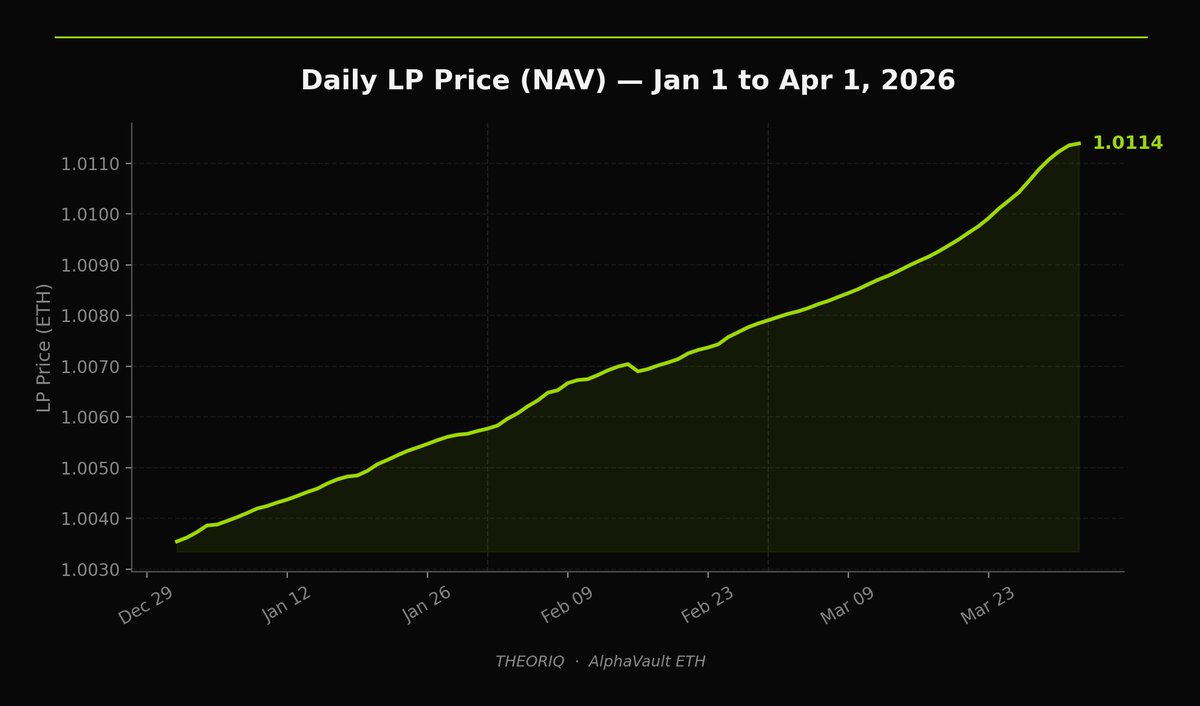
The NAV curve shows the same arc: steady accrual through January and February as the team rebuilt the strategy stack, then acceleration through March as the new pillars compounded into the curve. The brief flattening visible in mid-February tracks the period of tighter WETH credit conditions that the curation team navigated in real time, covered in detail further down.

The risk-adjusted picture is what matters most for an ETH yield product. A Sharpe of 4.14 across the quarter and a Calmar of 148.24 reflect both the contained drawdown and the steady contribution of the underlying strategy stack. The 30-day metrics are sharper than the 90-day numbers because they capture the period after the legacy unwind was largely complete and the new pillars were driving the book.
Those are the numbers, but they don't tell the story on how they were produced, and what our team accomplished.
What Changed in Q1
Three things drove the quarter:
1. A deliberate unwind of legacy ETH leverage
2. The standing-up of new strategy pillars across ETH credit and Pendle markets,
3. The integration of USD carry strategies into the curation pipeline.
Each one mattered on its own. Together they reshaped where AlphaVault ETH can find yield and how quickly it can rotate between sources.
Unwinding the legacy book
The portfolio began Q1 with concentrated exposure to legacy staked ETH and leveraged WETH loop configurations. As credit conditions tightened through January and into February, the asymmetry on certain leveraged carry trades deteriorated. The curation team gradually unwound StakeWise osETH exposure and reduced leveraged WETH loops, prioritizing exit quality over speed.
This was not a de-risking event. It was a quality upgrade: removing positions whose forward return profile had weakened, improving the portfolio’s convexity, and freeing up balance sheet capacity for the new strategy stack.
Building the new pillars
Two strategy families came online in January. The first was ETH credit allocation across Aave-related markets, spanning Core, Prime, Horizen, and Spark. The second was Pendle-compatible positioning across both principal token and liquidity provision implementations. Together these expanded the portfolio’s ability to express views across base carry and term-structure dislocations, with more granular risk allocation by market regime.
In parallel, the team formally integrated USD carry strategies into the internal oracle and curation pipeline. The shift was structural: USD carry stopped being an opportunistic side pocket and became a first-class part of the sourcing and deployment framework. That decision compounded through the quarter as new collateral types passed diligence and unlocked broader cross-venue arbitrage.
Capturing dislocations as they appeared
February brought a tighter WETH credit environment. Rather than absorb the drag passively, the curation team shifted to a more dynamic posture. Support for stETH withdrawals and additional Morpho markets came online, expanding the feasible unwind paths and letting the portfolio close debt at rates closer to fundamental exit values.
Later in the month, as debt-to-TVL improved and credit conditions loosened modestly, the portfolio captured a dislocation between secondary wstETH/WETH pricing and the native withdrawal queue. The trade was modest in size. The category is what matters: small individually, scalable in aggregate, and dependent on the kind of infrastructure flexibility most participants do not have. AlphaVault ETH is built to find more of them.
February was less about adding gross exposure and more about improving the quality of balance sheet utilization: preserving optionality, minimizing carry drag, and continuing to transition legacy positions without sacrificing execution discipline.
Expanding the USD opportunity set
March was the broadest expansion of the quarter on the USD side. sUSDe redemptions were added as an active strategy component, opening access to stablecoin basis and redemption mechanics in markets where secondary pricing diverged from creation value. sNUSD (Neutrl) cleared internal diligence and became a supported strategy. Within Morpho, sUSN and savUSD passed diligence and became eligible collateral for borrowing and lending workflows.
Each new asset clears the same internal review before it is eligible for capital: risk controls, redemption pathways, and collateral quality have to meet defined standards. The bar matters. It is what allows the vault to expand into vetted synthetic and structured dollar exposures rather than staying inside a narrow stablecoin set.
These approvals enabled active deployment of cross-venue USD lending arbitrage across multiple Morpho markets. As collateral preferences, utilization rates, and borrower demand diverged across pools, the portfolio allocated capital to capture spread differentials. The trade is modular, scalable as infrastructure improves, and not dependent on any single directional macro view.
Cross-chain infrastructure
Plasma deployment went live in March as part of the growing cross-chain capability stack, with HyperEVM integration expected to follow. Alpha in onchain credit increasingly depends not just on identifying mispricings, but on the ability to move capital quickly, validate risk in real time, and transact across fragmented environments with minimal operational friction. The Q1 infrastructure work strengthens that foundation.
How AlphaVault ETH Manages Risk
Risk management through Q1 centered on three priorities.
Reducing concentration in legacy ETH structures
The portfolio continued to move away from concentrated exposure in legacy staked ETH and leveraged loop configurations where returns had compressed and liquidity or funding conditions were becoming less favorable. The unwind was intentionally gradual to avoid sacrificing exit quality or introducing unnecessary slippage.
Expanding venue and collateral optionality
Optionality was the recurring theme. Adding stETH withdrawal support, new Morpho markets, additional collateral types, and broader USD strategy pathways improved the portfolio’s ability to route around local dislocations and reduce dependency on any single venue or instrument.
Improving execution infrastructure
The deployment of additional oracle and curation support for USD carry, alongside the cross-chain rollout, reflects a broader institutionalization of how the vault operates. As the strategy set broadens, execution quality increasingly determines realized returns. Infrastructure is part of that performance.
Q1 Operational Milestones
For the operationally minded, the full list of what shipped, integrated, or came online in Q1:
— Integration of USD carry strategies into the oracle and curation pipeline
— Expansion of active cross-venue rebalancing capabilities for ETH credit
— Enablement of stETH withdrawal support for more efficient deleveraging and liquidity routing
— Addition of Morpho market support for expanded collateral and lending pathways
— Approval and onboarding of new supported assets (sNUSD, sUSN, savUSD) after internal due diligence
— Unwind of StakeWise osETH and strETH (Lido Strategy Vault Share) exposure
— Deployment of Plasma infrastructure to support cross-chain execution
— Preparation for HyperEVM integration to further expand market access
Looking Ahead
The most important change in Q1 was not any single strategy addition. It was the cumulative effect: lower concentration in legacy exposures, broader venue support, deeper collateral compatibility, expanded USD carry and relative value pathways, and improved infrastructure for cross-venue and cross-chain execution.
The focus areas for Q2:
— Continued reduction or optimization of residual legacy leverage where return asymmetry remains unattractive
— Scaling cross-venue USD lending arbitrage where spreads justify deployment
— Deeper utilization of newly approved collateral types within Morpho and related markets
— Further monetization of redemption-versus-secondary pricing dislocations
— Expansion of cross-chain deployment as Plasma matures and HyperEVM comes online
— Continued refinement of execution and curation systems to improve capital routing and risk-adjusted returns
The opportunity set remains compelling, particularly in markets where fragmented liquidity and heterogeneous collateral treatment create persistent pricing inefficiencies. AlphaVault ETH enters Q2 with a broader, more flexible book than it began the year with.
The work is what compounds.
Connect with Theoriq
Join the Theoriq Discord Community
Launch Theoriq Gold Vault
Launch AlphaVault ETH
Learn More about Theoriq
About Theoriq
Theoriq builds the risk and yield intelligence layer for tokenized markets. It turns tokenized assets into risk-managed yield through multi-asset and infra-agnostic DeFi vaults: curators set the strategy and the risk limits, and AI-assisted systems execute and monitor within them. Its flagship vault, AlphaVault ETH, applies this framework to ETH-native yield, and the Theoriq Gold Vault extends it to tokenized gold, with plans to extend the model to additional real-world assets. Learn more at theoriq.ai.